Winona Lake, the natural lake of about 570 acres beside Warsaw in Kosciusko County, Indiana, went by another name until 1895. Local histories and the federal record agree on what that name was: Eagle Lake. The resort that grew on the lake’s east shore in the 1880s launched its excursion steamboat on Eagle Lake and named its hotel the Eagle Lake Hotel, and the water kept the old name until a single change of ownership replaced it. Today the new name is everywhere: the lake, the town beside it, the historic district, and this website all carry it.
The backbone source for this article is the National Register of Historic Places nomination for the Winona Lake Historic District, prepared ahead of the district’s 1993 listing. It is the most carefully dated public account of the lake’s resort era, and where lighter sources disagree with it, I follow the nomination. The supporting sources, all linked in context and listed at the end, are the Kosciusko County Historical Society, the Village at Winona’s history page, and Grace College’s Winona History Center.
If you want the lake’s present-day measurements rather than its past, start with Winona Lake by the numbers.
The Eagle Lake resort era
Spring Fountain Park
The commercial resort on Eagle Lake was the work of the Beyer brothers. The National Register nomination records that between 1886 and 1892 the brothers bought land on the east side of the lake and established Spring Fountain Park. The Village at Winona’s history page fills in what the park offered: a hotel, a racetrack, and a roller coaster. That mix reads more like an amusement park than the religious retreat the grounds later became; the assembly era came second, layered onto a resort already built for summer crowds.
The lake was part of the draw from the first season. The Kosciusko County Historical Society’s day-by-day local history blog records that on June 19, 1886, the Daisy, a steam-powered excursion boat, was launched at Spring Fountain Park. The launch came in the park’s first summer, a year before the hotel was built, so visitors were paying to ride the water before there was a resort hotel to sleep in. The society’s entry writes the location as “Eagle (Winona) Lake,” a rendering that only makes sense after 1895, and a small marker of how completely the newer name took over.
The Eagle Lake Hotel
The Eagle Lake Hotel followed in 1887. On the date, sources differ in a small way: the National Register nomination says the hotel was built in 1887, while the county historical society dates its opening to May 1888. Both can fit a building constructed in one year and opened the next, and I use the nomination’s 1887 for construction. The hotel outlasted the resort that built it. After the 1895 renaming it became the Winona Hotel, and the nomination lists it as the oldest resource in the Winona Lake Historic District.
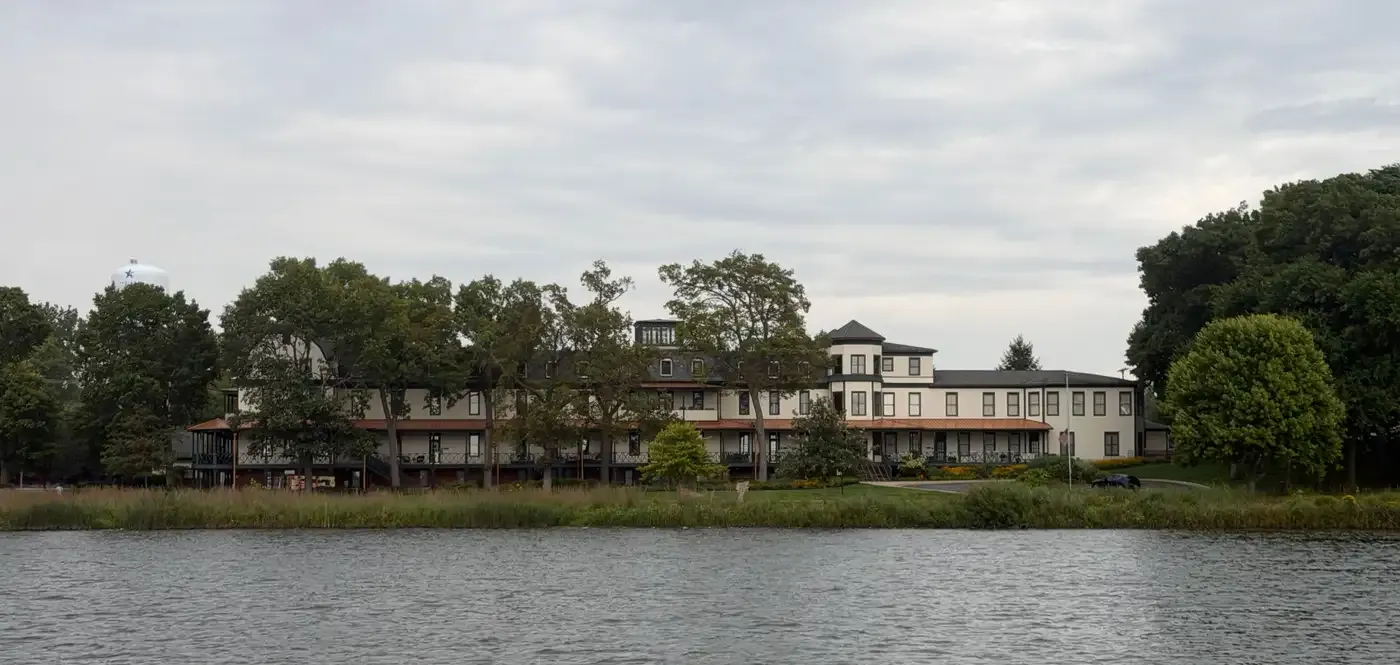
1895: the Winona Assembly renames the lake
The renaming started with a proposal. According to the nomination, Solomon C. Dickey proposed a Chautauqua-type institution in 1894, and in 1895 the Winona Assembly and Summer School Association was incorporated to build it. The new association purchased the Beyer land, platted lots for a summer community, and renamed the lake Winona Lake. One dating note for anyone comparing sources: the Village at Winona places Dickey’s purchase in 1894, while the nomination puts the incorporation and purchase in 1895. Where the two disagree, I follow the nomination.
The new name spread beyond the water. The Eagle Lake Hotel became the Winona Hotel, the freshly platted community took the Winona name, and the old name now survives mainly in Eagle Creek, the stream that carries the lake’s outflow toward the Tippecanoe River. Where does Winona Lake’s water come from? covers that plumbing in detail.
The nomination also gives the best short description of what the association built. It calls the community “a summer lakeside resort community founded by the Winona Assembly and Summer School Association” and, more specifically, “a unique religious Chautauqua community.” Chautauqua assemblies of that era paired religious programming with lectures, concerts, and outdoor recreation, which explains the range of people who appeared on these grounds over the following decades.
The Golden Age summers
The guest list gives the clearest sense of the community’s reach. The nomination names William Jennings Bryan, Will Rogers, John Philip Sousa, and Homer Rodeheaver among the figures who appeared at Winona Lake. Bryan had been a major-party nominee for president three times, and Sousa led the country’s most famous band, so the Chautauqua here was booking at a national level. Rodeheaver stayed attached to the community, and the Winona History Center’s exhibits still cover him alongside Billy Sunday. The setting for all of it was the east-shore ground bought from the Beyers, with the lake at its front door.
The Village at Winona describes roughly 1905 to 1915 as the community’s Golden Age and puts summer tourism in that period at 250,000. It comes from a promotional history of the resort era rather than from an audited count, so read it as the scale the community claimed at its height. It is also strictly historical; it says nothing about how many people visit the lake in any modern year. Even with both caveats, the figure shows how large the community believed its best summers to be.
Billy Sunday at Mount Hood
The nomination names one significant person for the district: the evangelist William Ashley “Billy” Sunday. Sunday built a bungalow he called Mount Hood at 1111 Sunday Lane in 1911 and lived there until his death in 1935. His wife, known as “Ma” Sunday, stayed in the house until 1957, which kept the home in family hands for 46 years.
The home is now a house museum with tours. For current visiting details, start from the Winona History Center page at Grace College, which covers the Sunday story as part of its own exhibits.
Bankruptcy and the last Chautauqua
The Assembly’s finances gave out in the middle of its best years. The Winona Assembly and Summer School Association went bankrupt in 1915, a year the nomination treats as one of the district’s three significant dates, alongside 1887 (the hotel) and 1895 (the founding and the renaming). A successor organization, the Winona Assembly and Bible Conference, continued the summer programming. The nomination records the bankruptcy without detailing its causes, and I will not guess at them here; what the dates show is that the community’s peak decade and its financial failure overlapped.
The Chautauqua format itself wound down over the decades that followed. The last Chautauqua program at Winona Lake ran in 1943, and the National Register’s period of significance for the district ends in that year. The community carried on past 1943, but that season closes the era the district was listed to preserve.
The historic district and the 1994 restoration
Formal recognition arrived fifty years after the last Chautauqua. The Winona Lake Historic District entered the National Register of Historic Places on December 10, 1993. The listed district covers about 48 acres and includes 98 contributing resources, the National Park Service’s term for the buildings and structures that give a district its historic character. The period of significance runs from 1887, the hotel’s construction year, to 1943, the final Chautauqua season.
Restoration followed almost immediately. The Village at Winona’s history describes a project, begun in 1994, that restored nearly 30 properties. Against a district of 98 contributing resources that is a large share handled in one effort, and it goes a long way toward explaining why the resort era is still visible on the ground today.
The timeline at a glance
The dates above in one place. Everything is from the National Register nomination unless noted otherwise.
| Year | What happened |
|---|---|
| 1886 | The Beyer brothers begin buying land on the east side of Eagle Lake; on June 19 the steam excursion boat Daisy is launched at Spring Fountain Park (Kosciusko County Historical Society) |
| 1887 | The Eagle Lake Hotel is built; the district’s period of significance begins |
| 1894 | Solomon C. Dickey proposes a Chautauqua-type institution |
| 1895 | The Winona Assembly and Summer School Association incorporates, buys the Beyer land, plats lots, and renames the lake Winona Lake |
| 1905–1915 | The Golden Age, with summer tourism put at 250,000 (Village at Winona, promotional figure) |
| 1911 | Billy Sunday builds the Mount Hood bungalow at 1111 Sunday Lane |
| 1915 | The Assembly goes bankrupt; the Winona Assembly and Bible Conference succeeds it |
| 1935 | Billy Sunday dies; “Ma” Sunday stays in the home until 1957 |
| 1943 | The last Chautauqua program runs; the period of significance ends |
| 1993 | The historic district enters the National Register on December 10 |
| 1994 | Nearly 30 properties are restored (Village at Winona) |
Where to see the history now
Three stops cover most of what this article describes, all on the same side of the lake the Beyers first built on.
- Winona History Center. The center occupies Westminster Hall on the Grace College campus at 105 9th Street, and its exhibits cover the Chautauqua movement, the Bible conferences, Billy Sunday, and Homer Rodeheaver. Details are on Grace College’s Winona History Center page.
- Billy Sunday Home. The Mount Hood bungalow at 1111 Sunday Lane is preserved as a house museum with tours. It is a separate building from the History Center, so check the center’s page for how visits currently work.
- The lake itself. The explore page covers public ways to experience the lake today, and the timelapses show the modern shoreline in motion.
Before you go
If you want the full record, the National Register nomination PDF is the deepest single document linked here, and the Kosciusko County Historical Society’s blog serves county history in short daily pieces like the Daisy entry.
For the lake’s present-day figures, Winona Lake by the numbers gathers the verified present-day figures with their sources, and the watershed article follows the water from the feeder ditches through the lake and out through Eagle Creek.
And if the steamboat era leaves you wanting time on the water, the explore page is the practical starting point.
Support the organizations in this article
The lake this history happened on is looked after today by three local organizations. The Winona Lake Preservation Association is the volunteer association on this lake, and it takes donations by Venmo and PayPal. The Watershed Foundation funds and builds the upstream projects that protect the lake; it accepts a one-time donation or a monthly gift. The monitoring and research behind this article are the work of the Lilly Center for Lakes & Streams at Grace College, which accepts gifts toward its research and education.
More about the local organizations, and other ways to help, is on the stewardship page.
Sources
- National Register of Historic Places nomination, Winona Lake Historic District: the primary source for district dates, resources, and the resort-era narrative. Checked August 17, 2026.
- Kosciusko County Historical Society, Another Day in History: the June 19, 1886 launch of the excursion boat Daisy at Spring Fountain Park. Checked August 17, 2026.
- Village at Winona, Our Story: Spring Fountain Park's amenities, the Golden Age tourism figure, and the 1994 restoration of nearly 30 properties. Checked August 17, 2026.
- Grace College, Winona History Center: the museum's location in Westminster Hall at 105 9th Street and its exhibit coverage. Checked August 17, 2026.