Postcards were the cheap photograph of their day, and Winona Lake sold a great many of them. The Chautauqua summers described in the lake's history brought visitors from several states, and most of them wanted to send something home. The seven cards below were bought for this site over the summer. Four were mailed, with messages in pencil and ink still legible on the backs, and three were never sent. Together they cover about forty years of the lake's appearance, from a canal only a few years old to a hotel that is still standing.
Each card is shown twice, picture side and address side, because the backs carry most of the dating evidence. Any card opens at full size in a new tab if you click it, which is the only way to read the pencil. The scans are lightly cleaned of specks and scanner dust; the pencil, the postmarks, the foxing, and one dealer's price are all left as found.
How the cards are dated. The Smithsonian Libraries' summary of postcard eras gives the outline: messages were first allowed on the back of a privately printed card on March 1, 1907, which began the divided-back era; publishers added a white border around the picture from about 1915 to 1930; and cards printed on textured rag stock, the linen cards, ran from about 1930 to 1945. Two of the cards were printed by Curt Teich of Chicago, whose production numbers are dated in the Newberry Library's dating guide. Where a card was mailed, the postmark and the stamp design narrow the date further.
1908: The Canal
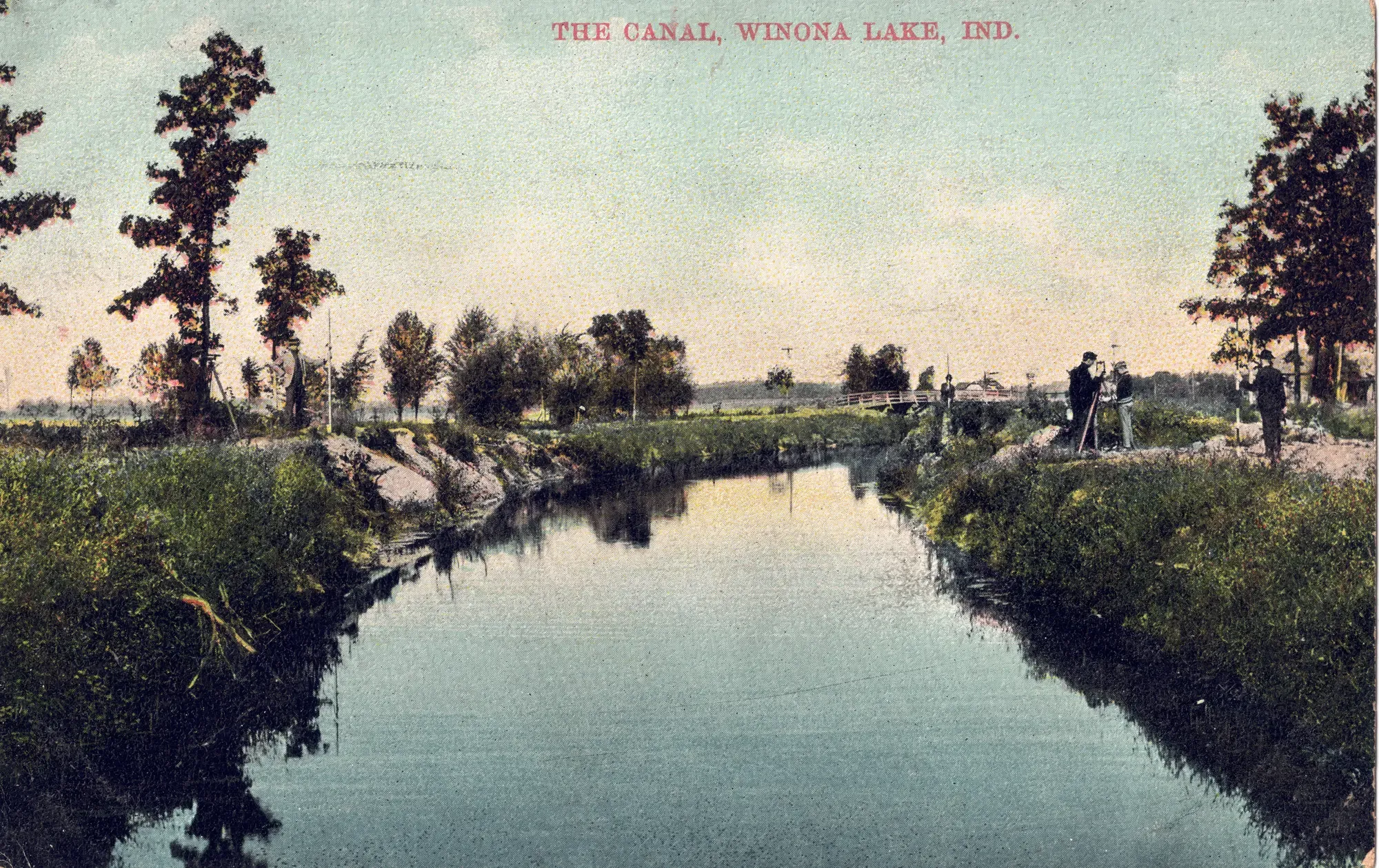
The oldest card in the set is also the one with the most to say about the ground it shows. Winona Lake has two canals, and the American Canal Society's index entry for them describes both. One ran northwest from the corner of the lake toward the railroad station in Warsaw, and steamboats carried passengers along it to the resorts on the east shore until an electric railway took over in 1902. The other was dug around 1902 through a low peninsula on the east side of the lake, creating McDonald's Island, "later shortened to 'The Island'", and the excavated earth was piled up to make house lots. The society records that the northwest canal was eventually filled in at its Warsaw end and that the island canal remains. The card does not say which canal it shows. A cut this straight, with a footbridge across it and people standing on the bridge, fits the island canal, which was only about six years old when this card was mailed.
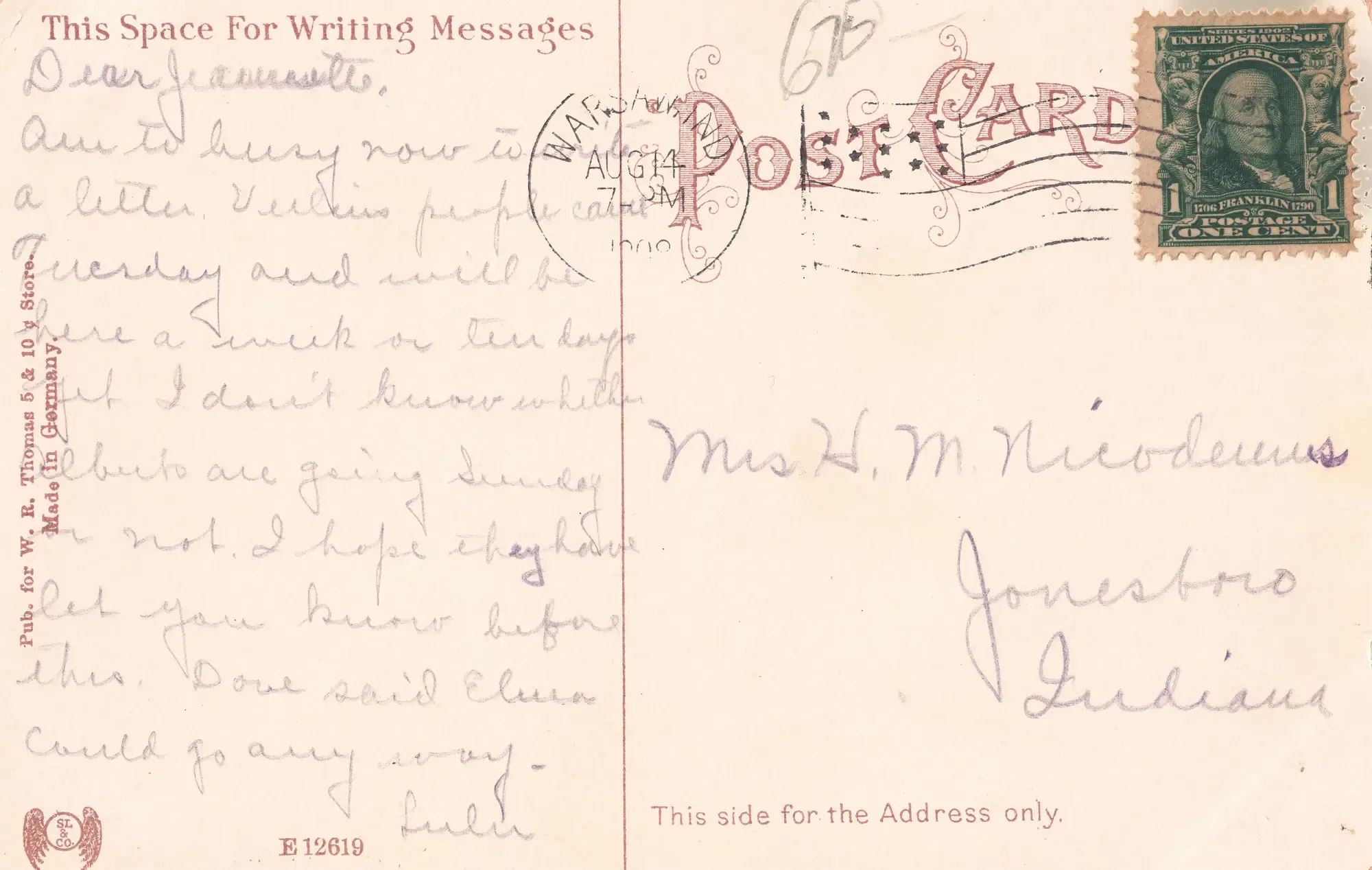
The back names the publisher as the W. R. Thomas 5 & 10 cent store in Warsaw and says the card was made in Germany, which is where most of the better color postcards sold in the United States were printed before the First World War. The back also carries an eagle logo with the initials S.L. & Co., which the card does not explain, and the number E 12619.
The message is in the purple of an indelible pencil, and most of it can still be read. It was addressed to Mrs. H. M. Nicodemus of Jonesboro, Indiana:
Dear Jeannette. Am to busy now to write a letter. [Verlin's?] people came Tuesday and will be here a week or ten days yet. I don't know whether [Alberts?] are going Sunday or not. I hope they have let you know before this. Dove said Elma could go any way. Lulu
Two things date the card independently of the cancel. The stamp is the green one-cent Franklin of the series of 1902, issued in February 1903 and superseded in late 1908, and the back is divided for a message, which was not permitted before March 1907. The Warsaw postmark, dated August 14, 1908, sits inside that window. A dealer has since added a price in ordinary pencil above the stamp.
Where the camera stood. On the east shore, south of The Island, looking south along the canal. The cut is still there, and today the shops and restaurants of the Village at Winona line it; the paddling guide treats it as the calm-water route.
1911: Moonlight on Winona Lake
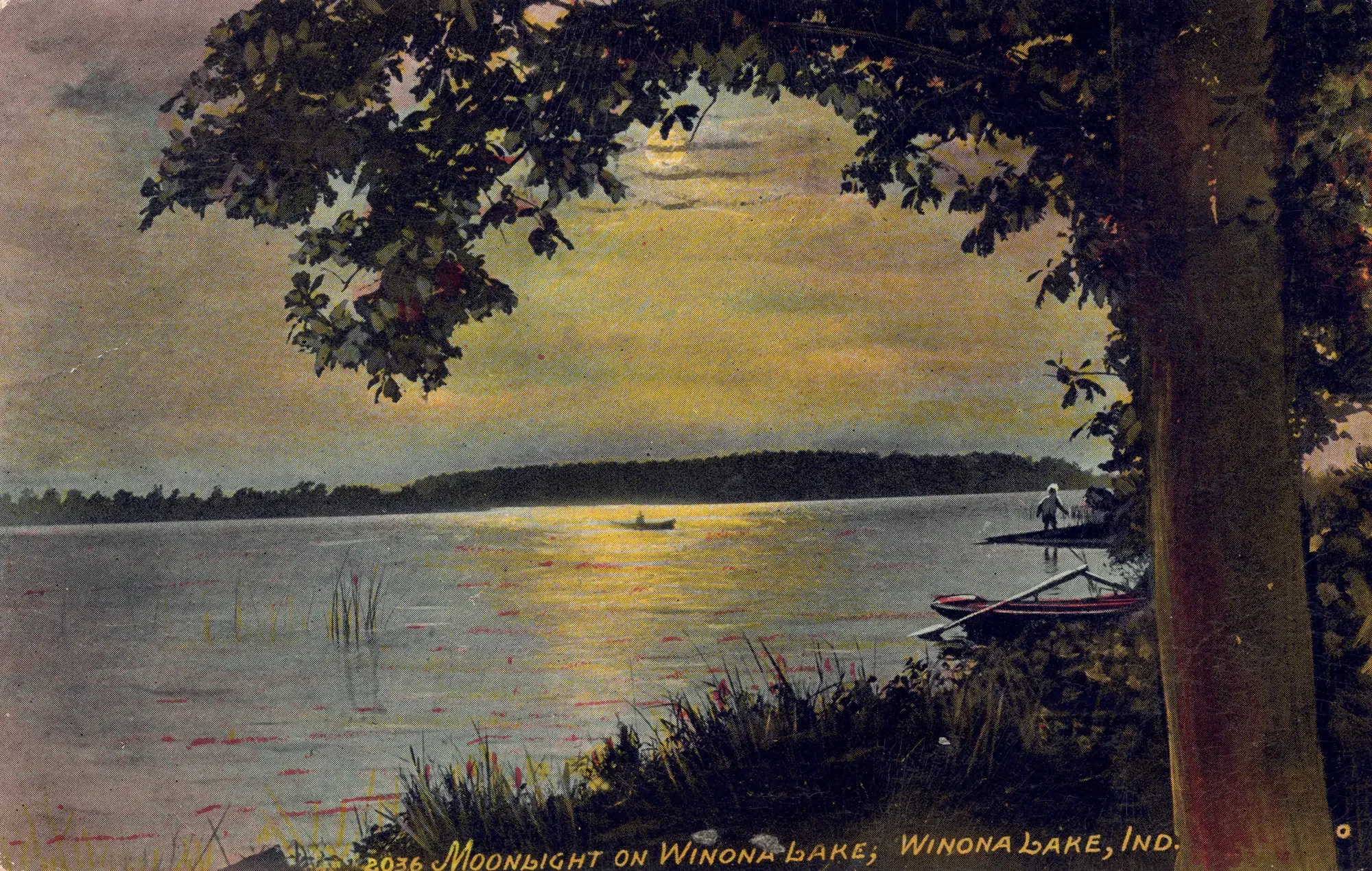
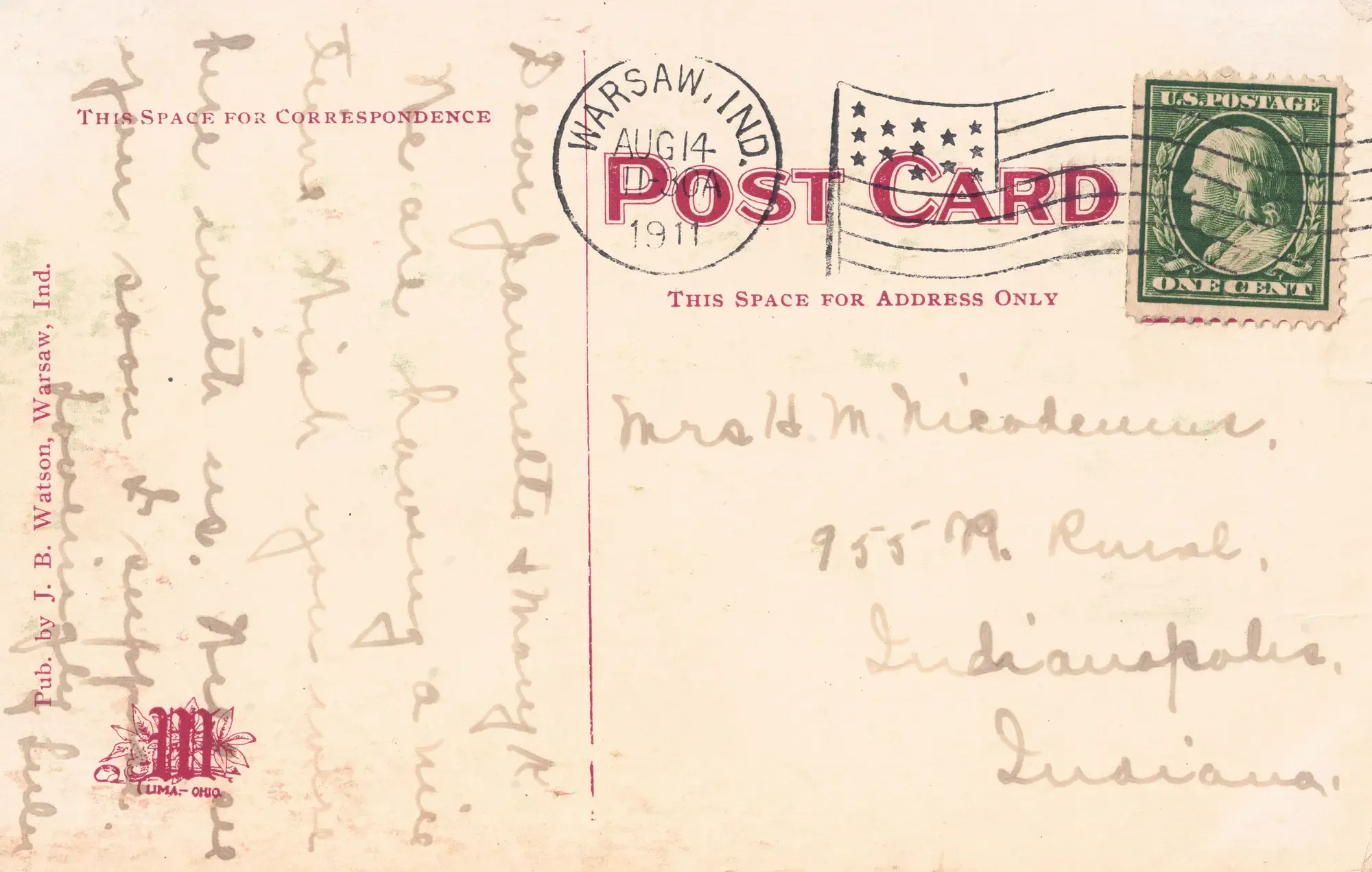
The second card is a night scene, or is printed as one. A big tree fills the right side and its canopy hangs over the top of the picture, a rowboat is pulled up on the bank with a figure standing at the water's edge beside it, a second boat sits out on the water in the track of the moon, and the far shore is a dark line under a yellow sky. Whatever the camera saw, the moon and the color are the printer's work, and the result was a popular kind of card in these years. The back names the publisher as J. B. Watson of Warsaw and carries a monogram with the words Lima, Ohio, the mark of the firm that did the printing.
The address is the reason this card belongs next to the canal. It went to Mrs. H. M. Nicodemus, the Jeannette of the 1908 card, who had moved in the meantime from Jonesboro to 955 N. Rural in Indianapolis, and it is signed by the same Lulu. Both cards went through the Warsaw post office on August 14, three years apart, which suggests a family with a standing August week at the lake. The pencil has faded further than on the older card, but the message reads:
Dear Jeannette & Mary K. We are having a nice time. Wish you were here with us. Will see you soon I suppose. Lovingly Lulu
The stamp is the green one-cent Franklin of the Washington-Franklin series that began in November 1908, with the denomination spelled out as "one cent". That design stayed on the one-cent stamp until Washington replaced Franklin on it in early 1912, so the stamp and the 1911 cancel agree.
Where the camera stood. On the east shore just south of today's Limitless Park, looking west-southwest across the widest part of the lake, which is why the far shore is a single low line.
1912: Fair View, hand colored
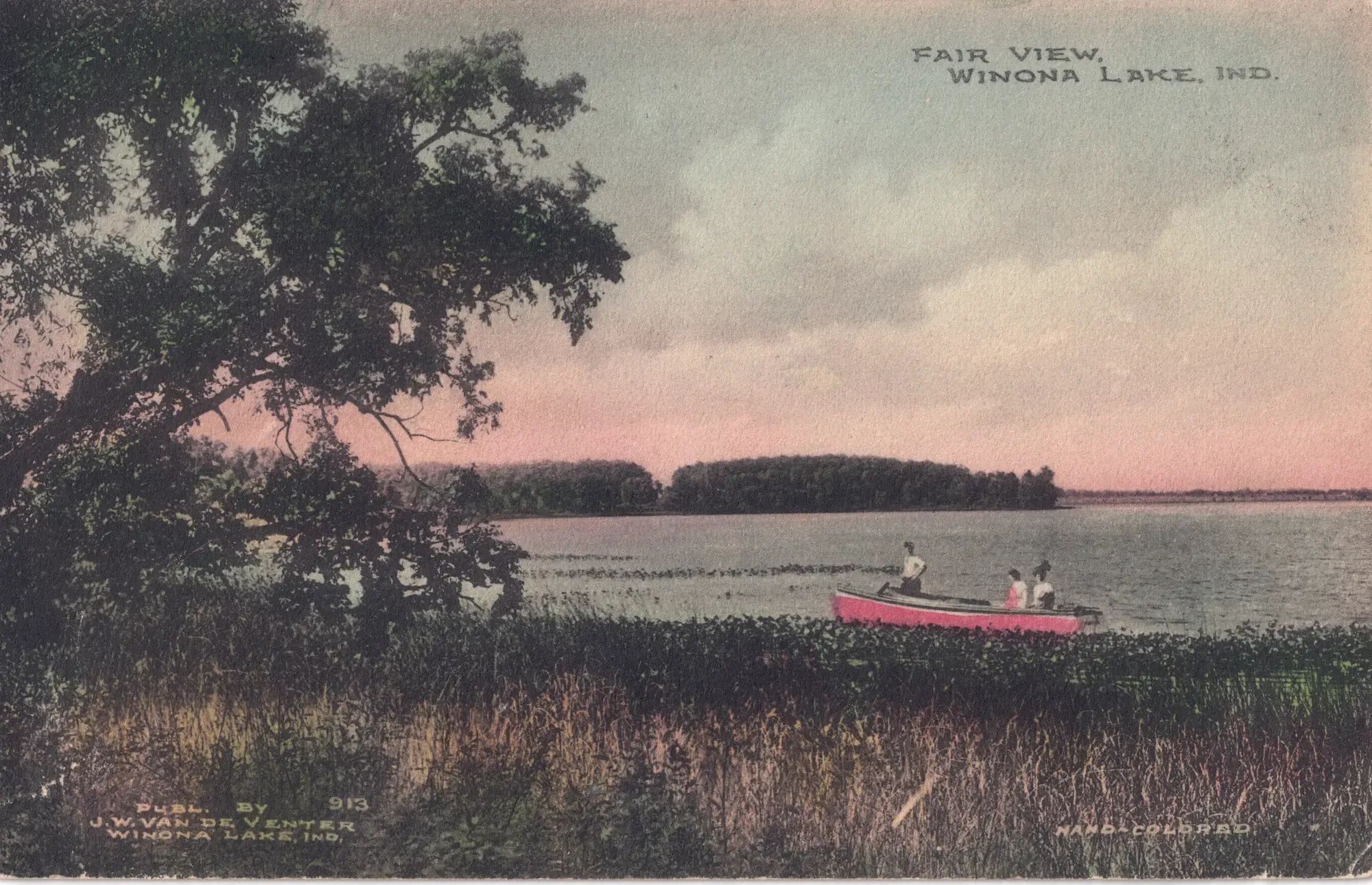
This is the only card of the seven whose publisher was in Winona Lake itself. The bottom edge of the picture reads "Publ. by J. W. Van De Venter, Winona Lake, Ind." and, at the right, "hand-colored". Van De Venter published a whole line of Winona Lake views in these years, and a card of his in Grace College's postcard collection carries a note that he was also the author of the hymn "I Surrender All" and lived at Vaneta Cottage at College Avenue and Eleventh Street. Hand-colored cards were printed from a black and white photograph and tinted afterward, by hand or through stencils, which is why the sky on this one is a pink no camera of the period could have recorded.
The view itself is from a marshy stretch of shore looking out across the water, with a red canoe and two people in it a little way out. The card gives no compass direction and the site does not appear on any map by that name, so "Fair View" is best read as a picture title rather than a place.
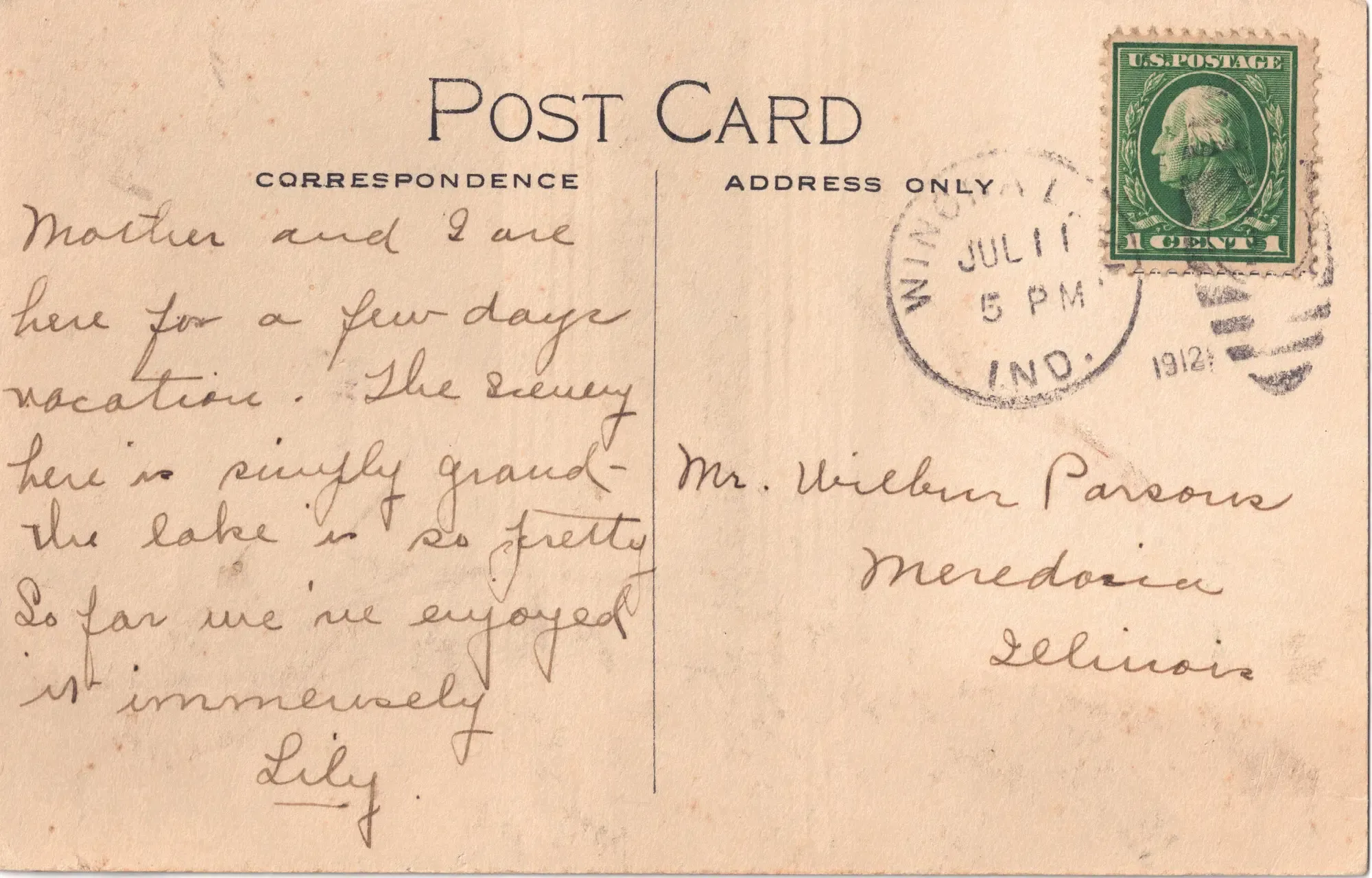
The message, in pencil, was sent to Mr. Wilbur Parsons of Meredosia, Illinois, a river town on the Illinois about 300 miles west of here:
Mother and I are here for a few days vacation. The scenery here is simply grand. The lake is so pretty. So far we've enjoyed it immensely. Lily.
The postmark reads Winona Lake, Ind., July 11, 1912, with a Washington one-cent stamp. The Post Office had put Washington's profile on the one-cent stamp earlier that year, replacing Franklin, so Lily bought a stamp design that was only months old.
Where the camera stood. On the north shore, west of the modern boat ramp at Kiwanis Park, looking east along the shore. The title may be a plain compliment or a nod to the county fairgrounds, which today sit on this same north shore on East Smith Street. A 1942 history of the county fairs records that the fair society collapsed in 1885 and that a free street fair began in 1906, and does not say when the fair took up its lakeside grounds, so the connection stays a guess, and the camera may have stood a little farther east than the map shows.
1912 or later: looking toward Winona Lake
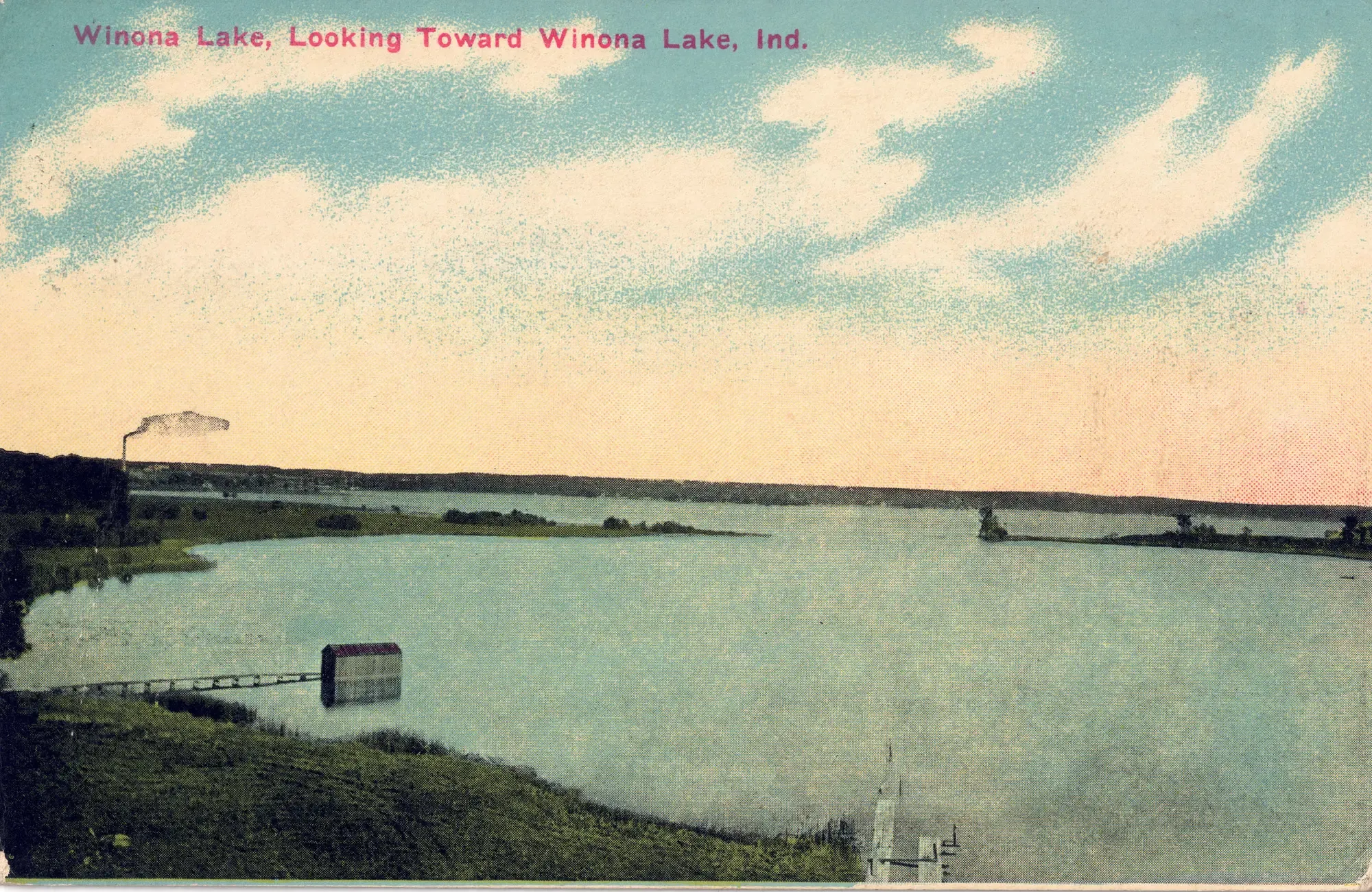
The title on this card reads "Winona Lake, Looking Toward Winona Lake, Ind.", which only makes sense once you remember that the town and the lake share a name. The view is from a low, open shore across the water toward the town side, where a long pier runs out with a small pavilion at its end and a smokestack shows above the trees to the left. A short wooden pier is in the foreground.
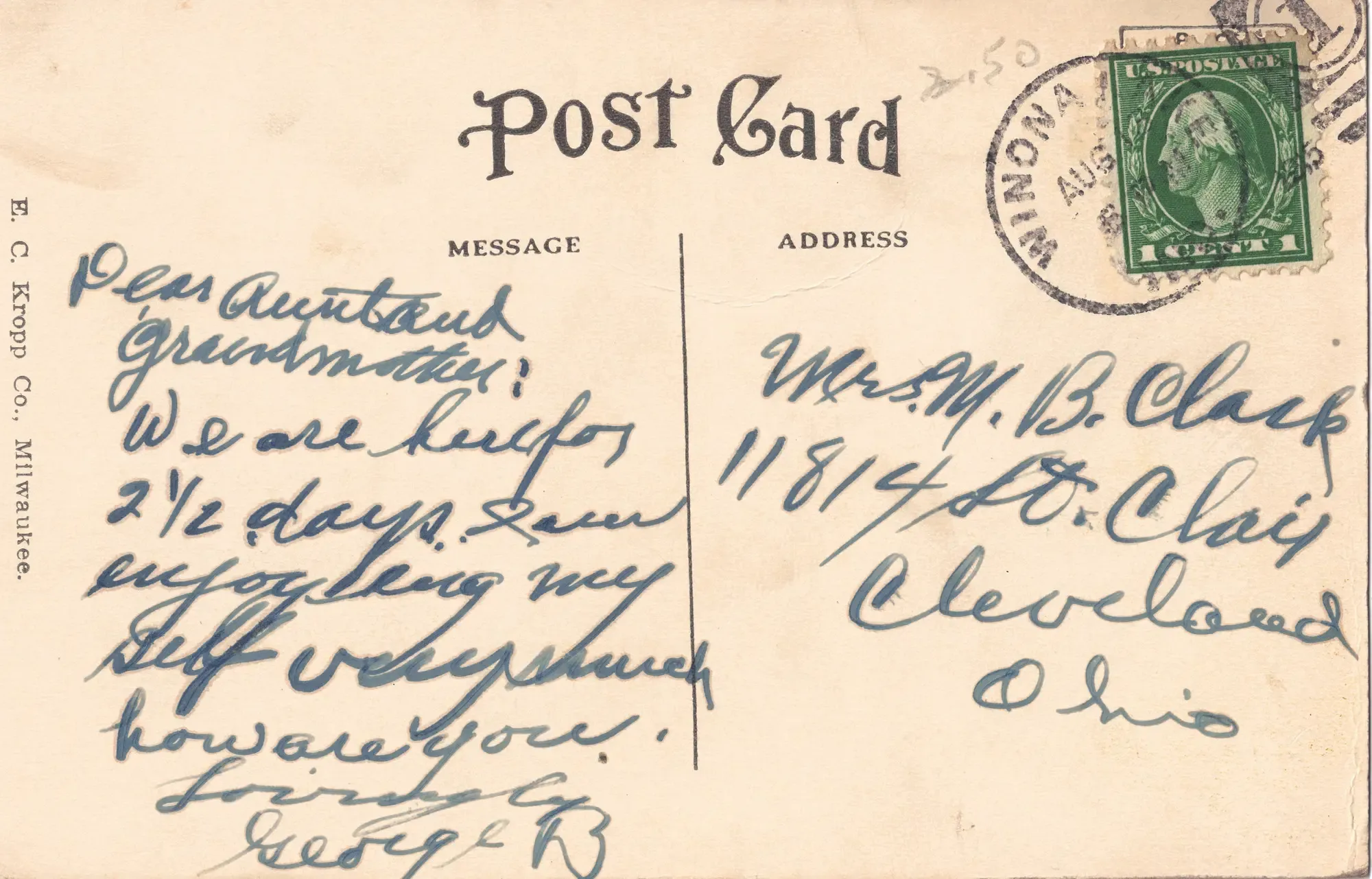
The publisher is E. C. Kropp Co. of Milwaukee, a firm that printed view cards under that name from 1907 until it was sold in 1956. The stamp is the same Washington one-cent that dates the Fair View card, so this one was mailed in 1912 or later, and the Winona cancel shows only the month, August. The message is in blue ink, addressed to Mrs. M. B. Clark, 11814 St. Clair, Cleveland, Ohio:
Dear Aunt and Grandmother: We are here for 2 1/2 days. I am enjoying my self very much. how are you. Lovingly George B.
Where the camera stood. On the west shore of the northwest arm, the part of the lake known locally as Little Eagle, looking east-northeast across the arm and the main basin toward the town. I read the smokestack at the left as the Dalton foundry's, whose stacks still stand on East Jefferson Street in Warsaw. Dalton's own history says the firm was founded in 1910 on Warsaw's west side and moved to East Jefferson Street when it outgrew that site, and the Warsaw plant closed in February 2026, a month after its owner announced the shutdown. If the stack is Dalton's, the card is no older than that move.
1921: two views from an aeroplane
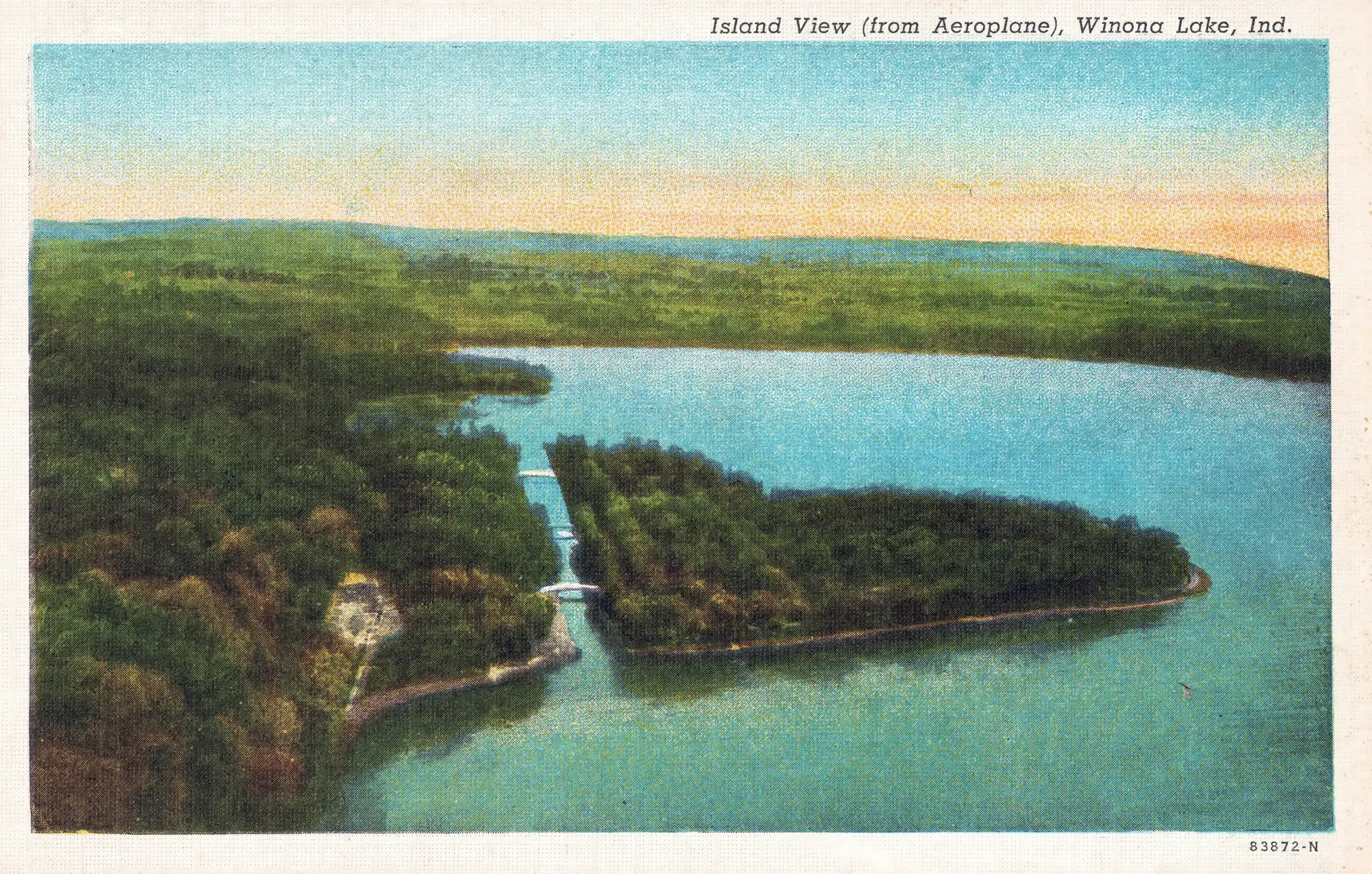
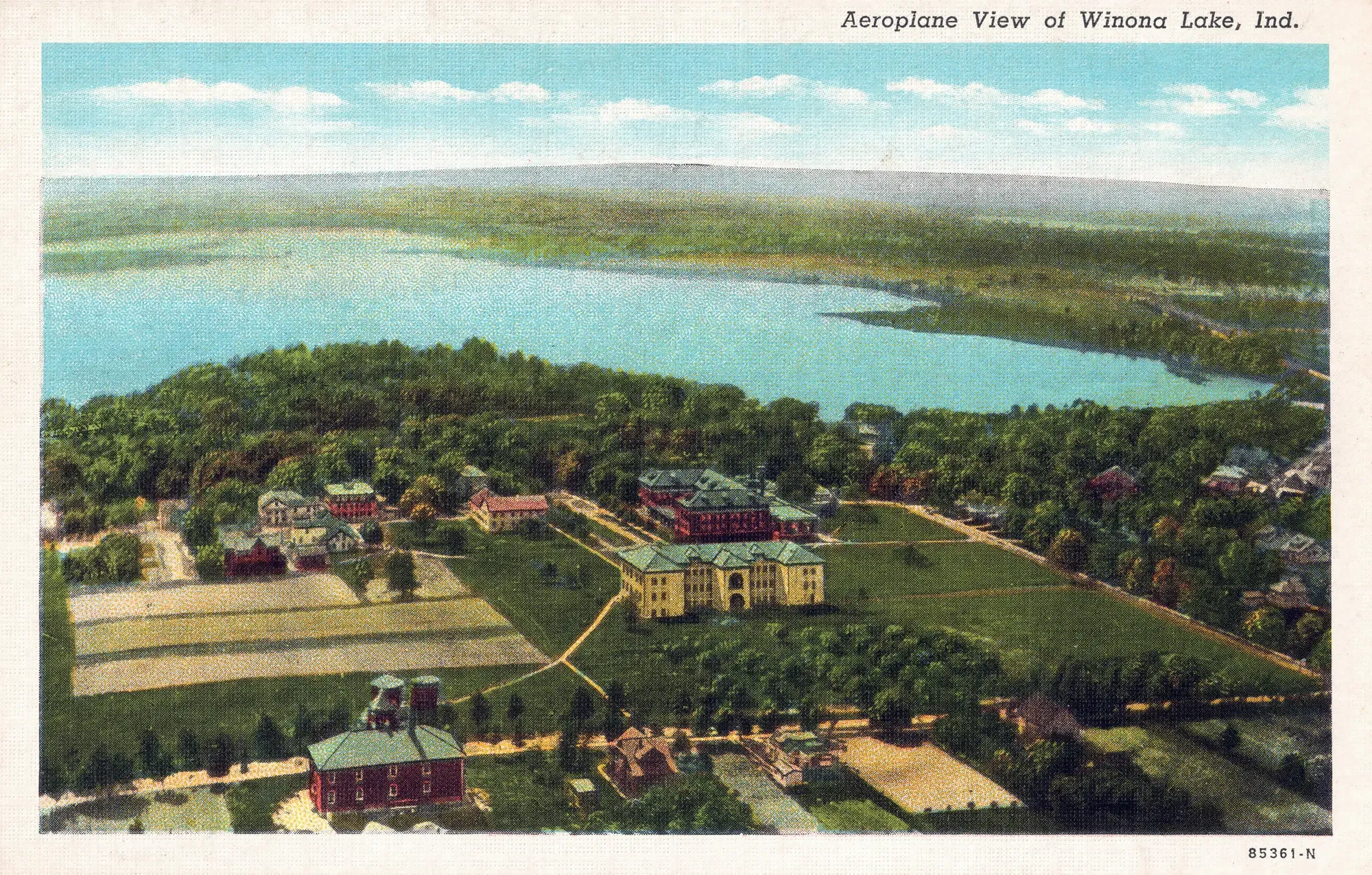
These two are a pair: white-bordered cards printed by Curt Teich & Co. of Chicago, the largest postcard printer in the country, for a local publisher that signed itself the Winona Lake Institution. Both were made from aerial photographs, which were a novelty in the early 1920s, and both are of the east shore. The first looks down on The Island, the wooded triangle cut off from the shore by the canal dug around 1902, with two bridges across the cut and the open farmland north of the lake beyond it. The second looks out over the assembly grounds, with two large buildings on open lawns, cottages among the trees, and the whole lake laid out behind them to its far shore.
The production numbers date them. Teich numbered its cards in sequence, and the Newberry Library's guide places 83600 through 87975 in 1921, which takes in both 83872 and 85361. The guide also explains the suffix: an "-N" after the number "indicates it was a reprinted card", and after about 1924 the "A" that normally preceded the number was often dropped, as it is here. So the photographs were made and the cards first printed in 1921, and the two copies here are reprints run off some years later, when the views were still selling. Neither was mailed, and neither carries a date beyond the number.
For anyone who wants to check the arithmetic, the Newberry holds the Teich company's own production files, the largest public postcard archive in the country, and its Curt Teich Postcard Archives research guide explains how to look a number up.
Where the cameras were. The island view was taken from over the island's north tip looking south, with the canal on the left and the open lake on the right. The second view was taken from over the east shore looking west-northwest across the assembly grounds, on ground that is now the Grace College campus, with the whole lake beyond and the Little Eagle arm in the far distance. Grace did not settle at Winona Lake until 1939, so in 1921 the buildings in the foreground belonged to the assembly.
The linen era: the Winona Hotel
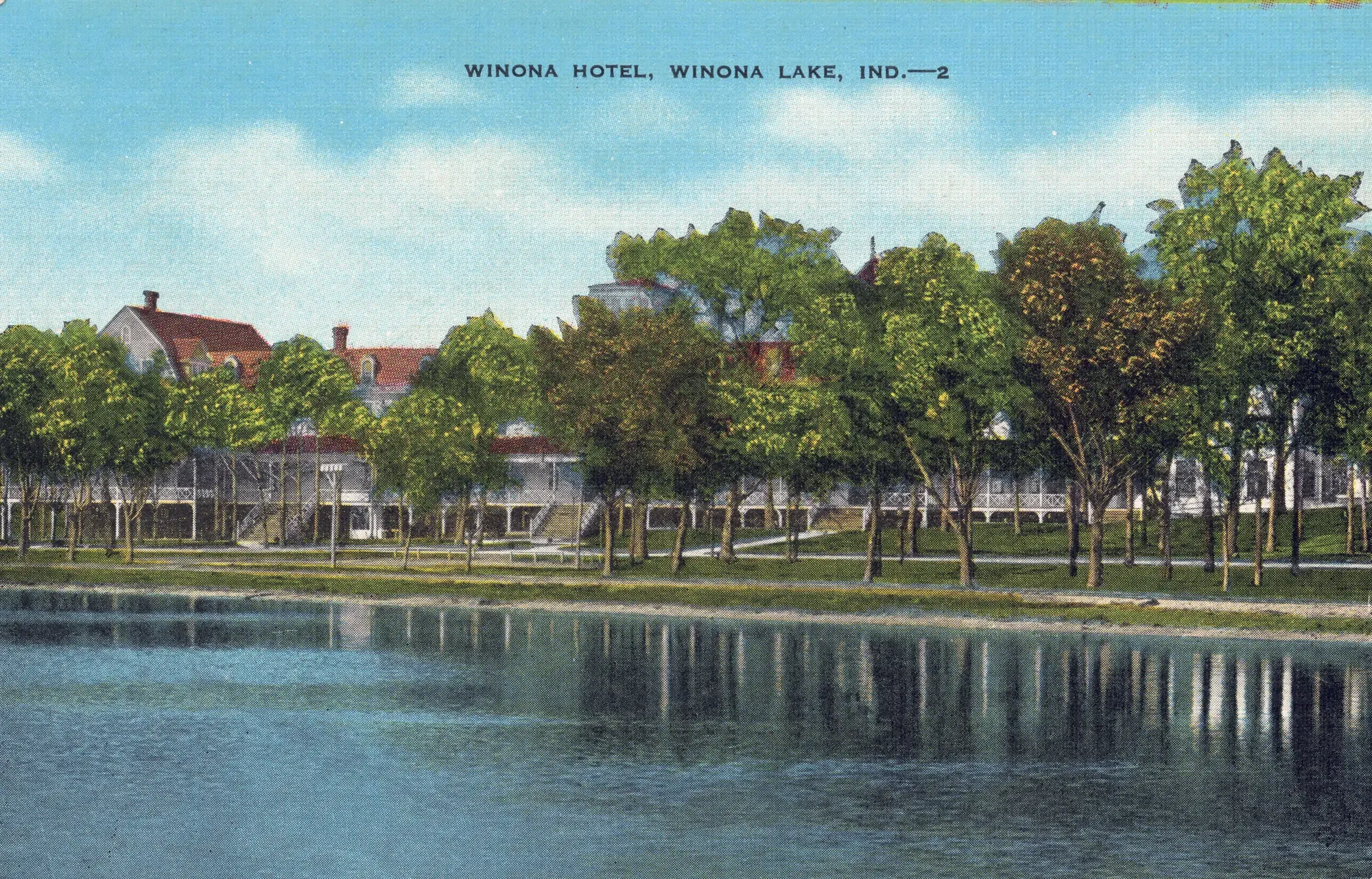
The newest card is the one whose subject is easiest to find today. The Winona Hotel was built in 1887 as the Eagle Lake Hotel, renamed after the 1895 purchase that renamed the lake, and is listed as the oldest resource in the Winona Lake Historic District; the history article has the dates, and a photograph of the same building from the water today. On the card it is a long white three-story block with covered porches, seen across the water through a screen of shoreline trees, with the bright, slightly unreal blue sky that linen cards were known for.
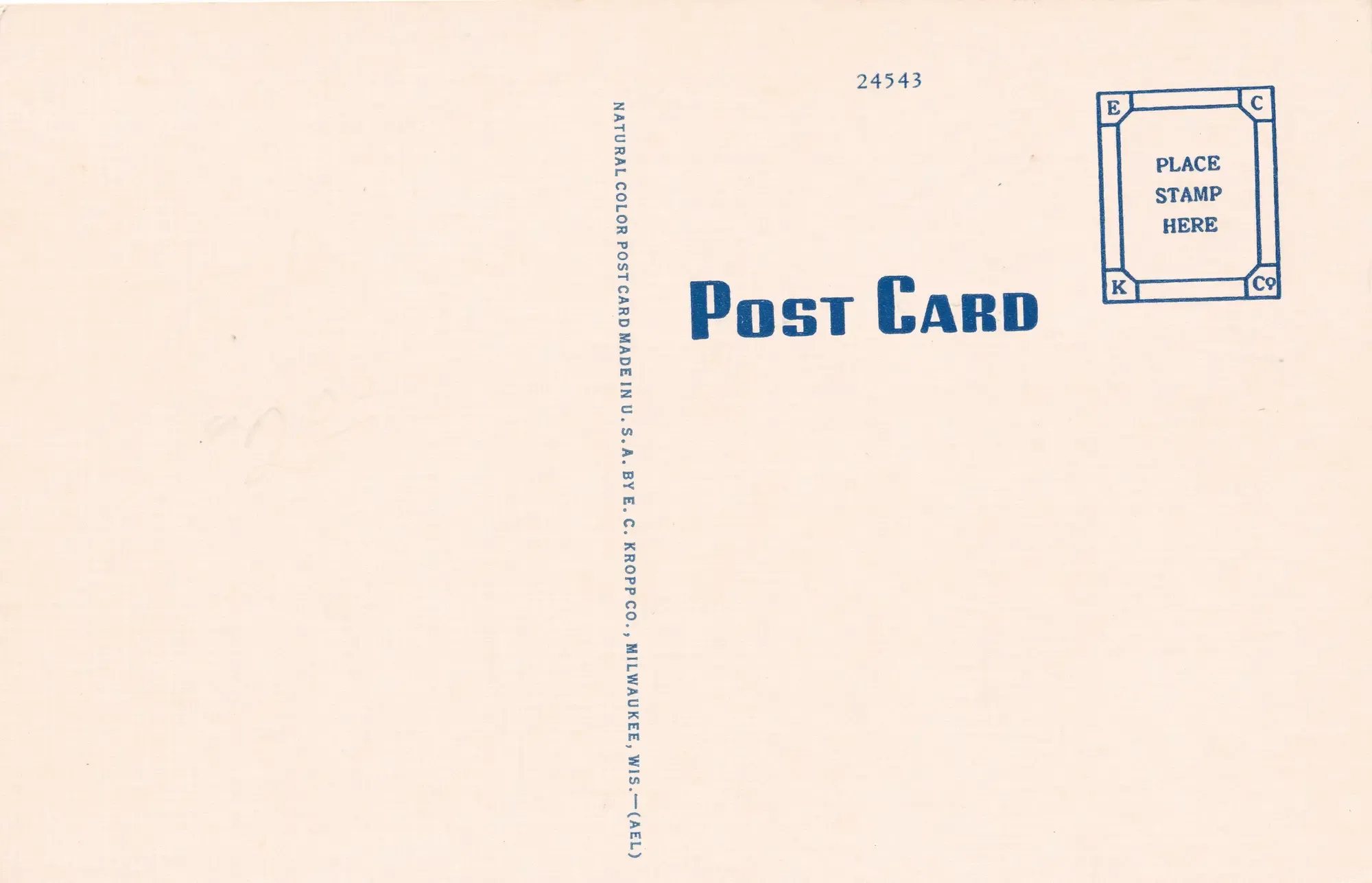
The back calls it a "Natural Color Post Card made in U.S.A. by E. C. Kropp Co., Milwaukee, Wis.", and the stock has the woven texture of a linen card, which puts it in the period from about 1930 to the mid-1940s by the Smithsonian's eras, and no later than Kropp's sale in 1956. Kropp did not date its cards, and this one was never mailed, so the range is as close as the card itself allows.
Where the camera stood. On the shore southwest of the hotel, looking northeast across the water, close to where the history article's photograph of the building was taken from a boat.
Where the cameras stood
The map puts the seven cards on the lake, numbered in the order they appear above, each with a wedge showing the direction the camera faced. The positions are mine, worked out by matching shorelines, buildings, and the run of the canal against the ground as it is today, and they are good to about a block. Five of the seven are on or over the east shore, within about a mile of each other, which is where the assembly, the hotel, and the postcard racks all were. The northwest arm carries the name locals use for it, Little Eagle, and the town of Winona Lake sits on the east shore beyond the frame.
The seven cards at a glance
| Card | Printed by | Date and the evidence for it | Where |
|---|---|---|---|
| The Canal | Germany, for the W. R. Thomas 5 & 10 cent store, Warsaw | Mailed August 14, 1908 (Warsaw postmark; series of 1902 Franklin stamp) | 1. East shore, looking south down the canal |
| Moonlight on Winona Lake | J. B. Watson, Warsaw; printed in Lima, Ohio | Mailed August 14, 1911 (Warsaw postmark; 1908 series Franklin stamp) | 2. East shore near Limitless Park, looking west-southwest |
| Fair View | J. W. Van De Venter, Winona Lake, hand colored | Mailed July 11, 1912 (Winona Lake postmark; 1912 Washington stamp) | 3. North shore, looking east |
| Looking Toward Winona Lake | E. C. Kropp Co., Milwaukee | Mailed in August of 1912 or a later year (stamp design; year did not print) | 4. West shore of Little Eagle, looking east-northeast |
| Island View (from Aeroplane) | Curt Teich, Chicago, for the Winona Lake Institution | Photographed and first printed 1921 (number 83872); this copy a later reprint | 5. Over the island's north tip, looking south |
| Aeroplane View of Winona Lake | Curt Teich, Chicago, for the Winona Lake Institution | Photographed and first printed 1921 (number 85361); this copy a later reprint | 6. Over the east shore, looking west-northwest |
| Winona Hotel | E. C. Kropp Co., Milwaukee | Linen era, about 1930 to the mid-1940s (card stock; never mailed) | 7. Shore southwest of the hotel, looking northeast |
Where to see more
Seven cards are a small sample. Grace College's Morgan Library has digitized several hundred Winona Lake postcards from the early 1900s to the 1970s, searchable by subject, and it is the first place to look for a view that is missing here, including the steamers, the auditorium, and the swimming beach. The Winona History Center in Westminster Hall covers the assembly years the cards were sold in. For the printing side, the Newberry Library's Teich archive documents the Chicago end of the trade, and the Smithsonian Libraries' postcard guide is the short course in reading a card's era from its back.
The lake in these pictures is the same lake, and the ground is mostly still there. The island canal can be paddled today, and the paddling guide treats it as the calm-water option on a windy day. The hotel is condominiums. The pier with the pavilion is gone, and the shore George B. wrote from has houses on it.
Support the organizations in this article
The postcard collection and the Winona History Center are both kept by Grace College, which accepts gifts toward the History Center. The lake in the pictures is looked after today by the Winona Lake Preservation Association, which takes donations by Venmo and PayPal.
More about the local organizations, and other ways to help, is on the stewardship page.
Sources
- The six postcards themselves, scanned at 1200 dots per inch, front and back. Publisher imprints, production numbers, postmarks, stamps, and messages are read from the scans. Scanned September 2026.
- Smithsonian Libraries and Archives, "Postcard Types": the undivided-back, divided-back (from March 1, 1907), white-border (1915 to 1930), and linen (1930 to 1945) eras. Checked September 12, 2026.
- Newberry Library, "Guide to Dating Curt Teich Postcards": production numbers 83600 to 87975 assigned to 1921, the "-N" reprint suffix, and the dropped "A" prefix after about 1924. Checked September 12, 2026.
- Newberry Library, Curt Teich Postcard Archives Collection research guide: the archive's scope and how to look up a production number. Checked September 12, 2026.
- American Canal Society, Canal Index, "Warsaw & Winona Lake Canals": the northwest canal and its 1902 replacement by an electric railway, and the canal dug around 1902 that created McDonald's Island, later The Island. Checked September 12, 2026.
- Series of 1902 (United States postage stamps): the one-cent Franklin issued February 3, 1903 and superseded in late 1908. Checked September 12, 2026.
- Washington-Franklin Issues: the series beginning November 1908 and the Washington one-cent released in early 1912. Checked September 12, 2026.
- Sent from the Past, E. C. Kropp Co.: the Milwaukee firm's dates, 1907 to its sale in 1956. Checked September 12, 2026.
- Indiana Memory, Grace College Winona Lake Postcards, "Various Scenes" (1911): a J. W. Van De Venter card with the archive's note on his hymns and Vaneta Cottage. Checked September 12, 2026.
- Grace College Morgan Library, digital collections guide: the Winona Lake Postcards collection of several hundred cards from the early 1900s to the 1970s. Checked September 12, 2026.
- Edwin C. "Toby" Aborn, "Kosciusko County Fairs," reprinting a Warsaw Daily Times article of January 6, 1942: the fair society's collapse in 1885 and the free street fair of 1906. Checked September 13, 2026.
- Dalton Databank, "History of the Dalton Foundries": founded 1910 on Warsaw's west side, later moved to East Jefferson Street. Checked September 13, 2026.
- WISH-TV, "Auto parts facility in Warsaw to close, affecting 262 workers," January 7, 2026: the closure of the Dalton plant at 1900 E. Jefferson St. on February 27, 2026. Checked September 13, 2026.
- Town of Winona Lake, History: Grace Theological Seminary's move to Winona Lake in 1939. Checked September 13, 2026.
- Camera positions and bearings for the map: Jonathan Ruddell, from the views themselves against the present-day shoreline, September 2026.
- Grace College, Winona History Center: the center's location in Westminster Hall and its coverage of the assembly era. Checked September 12, 2026.