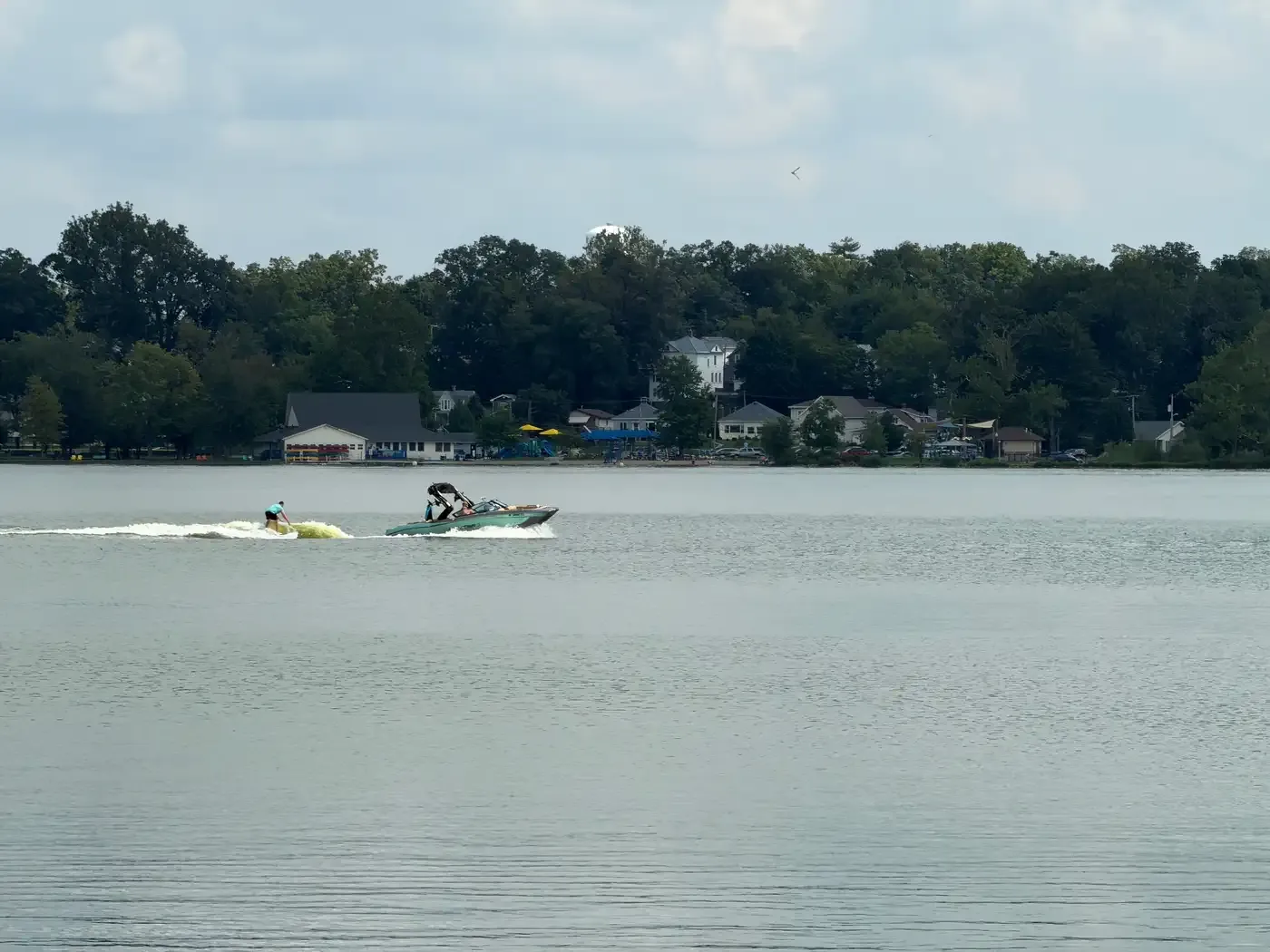
A wake boat running with full ballast is designed to push a large wave. The hull, the ballast tanks, and the surf system all exist to make the wave taller and cleaner than anything a ski boat leaves behind. What that wave does after the rider is done with it depends on where the boat is running: how much water sits under the hull, and how far the wave travels before it reaches a shoreline or a dock. Winona Lake gives you two tools for making that call well, a legal idle-speed loop and a detailed depth survey, and this site's boating lap map draws them on one screen.
Indiana's new wake law has also put a lot of numbers into circulation, and they carry different weight depending on where they come from. Some are law, some are published research recommendations, and some are this site's own voluntary guidance, and each section below says which is which.
The legal floor: what Indiana law requires
Two statutes cover wake sports on Winona, and both are explained at more length in the boating rules guide.
The first applies to every motorboat. Indiana Code 14-15-3-17 bars operating a motorboat faster than idle speed within 200 feet of the shoreline of a lake or its channels, and the code defines idle speed as the slowest possible speed, no more than 5 mph, that still maintains steerage with minimal wake. Around Winona, that 200-foot band forms a loop about 5.2 miles long. It is measured from the water's edge, so the line moves as the lake level moves.
The second is new. House Enrolled Act 1062, effective July 1, 2026, added a wake-sports section to the boating code: an individual may not operate a motorboat on a public freshwater lake for the purpose of wake boarding or wake surfing between sunset and sunrise. Violating it is a Class C infraction. The act also restricts wake surfing on lakes of 299 acres or less, but Winona, at 562 acres on the DNR's survey, sits well above that line, so daytime surfing is unchanged here. The Watershed Foundation's explainer lists Winona among the high-speed lakes where the nighttime prohibition is the only practical change.
That is the entire statutory picture. The act defines the sports, sets the sunset-to-sunrise rule, and stops. It contains no depth requirement and no wake-sport distance rule beyond the 200-foot idle zone that already applies to everyone.
What a ballasted wake does underwater
A surf wave is displaced water, and displacing that much water takes energy. A ski boat on plane sends most of its energy across the surface behind it. A ballasted wake boat rides stern-deep by design and directs far more of its energy downward. In deep water that energy spreads out and fades before it touches anything, but in shallow water it reaches the bottom.
Lake sediment stores phosphorus, and prop wash and wave energy that reach the bottom stir the sediment, and the phosphorus bound up in it, back into the water column. Phosphorus is the nutrient that feeds the algae Winona contends with every summer, which is why a wake thrown over a shallow flat stirs sediment and phosphorus while the same wake over the deep basin leaves the bottom undisturbed.
A wake also loses energy as it travels, so the farther from shore the boat runs, the smaller the wave that finally arrives at seawalls, moored boats, and docks.
The guidance in circulation, and who is behind each number
Because the statute is silent on depth and distance, guidance has filled the gap, and the numbers you will hear around the lake come from different sources with different levels of caution behind them.
- University of Minnesota research: 500 feet from shore, 20 or more feet of water. The Watershed Foundation's wake-law explainer relays these figures from University of Minnesota research on wake-enhanced boats. They circulated widely alongside the bill and are often repeated as if they were part of it; they are research recommendations, and HEA 1062 includes neither one.
- Boat dealers and lake associations: 10 to 15 feet. These are the most common depth figures in industry and lake-association material, and the least conservative on the list. No statute backs them either.
- This site: the mapped 20-foot area. The boating lap map shades the water 20 feet and deeper as the suggested surfing area, matching the research figure rather than the industry one. The page labels that choice as a conservative local judgment call, and no published standard backs it.
The Water Sports Industry Association's Wake Responsibly campaign, the industry's own courtesy effort, publishes no depth figure at all; its advice concerns distance and behavior, and it appears in the etiquette section below.
Where the deep water actually is
The Indiana DNR mapped Winona's bottom in an August 2017 bathymetric survey, with contours every 10 feet down to the 79-foot hole. The deep water concentrates in the main basin; the northwest arm, where Eagle Creek leaves the lake, runs mostly under 10 feet, with a single pocket past 20. This site's depth page reprints the survey, and the depth map guide walks through how to read it.
By the boating lap page's GIS extraction from that survey, 319 acres of Winona sit at 20 feet or deeper, a bit over half of the roughly 570-acre lake. (The depth page's independent extraction puts the same area at 316 acres; the two differ by about one percent.) By any figure on the guidance list above, Winona has room to surf.
Depth alone does not settle where, though. The west side of the lake drops off fast, and along parts of the west shore the 20-foot contour comes within about 110 feet of the bank. That water clears every depth recommendation in circulation, and it sits inside the 200-foot idle zone, where no motorboat may run faster than idle speed, which rules out throwing a surf wave there. Surfable water on Winona is the overlap: deeper than 20 feet and outside the 5.2-mile loop at the same time. The boating lap map shades exactly that overlap, so open it before you plan a line.
The basin also has structure worth knowing about. A mid-lake shoal south of the deep basin rises from more than 20 feet to less than 10 and then drops away again, with a second small shoal to its east. A track that looks deep on average can still cross shallow ground.
Etiquette that keeps the peace
Wake Responsibly, the industry campaign mentioned above, asks surfers to stay at least 200 feet from shore and docks, keep music at a reasonable volume, and avoid repeated passes over the same stretch of water. On Winona the first point matches the legal idle zone, so on this lake following it adds no new restriction.
The repeated-passes point deserves the most attention on a lake this size. Running set after set over one stretch concentrates wave energy on the same section of shoreline and the same patch of bottom all afternoon. Varying your track around the basin spreads that energy out, and it spreads out the noise as well. Sound carries over open water: what reads as background music at the wheel can be the loudest thing on someone's porch.
Before your first set
- Open the map. The boating lap page shows the idle-speed loop and the 20-foot area together, so the day's plan can start from the overlap instead of guesswork.
- Check conditions. Lake Today carries live weather, a five-day forecast, and a watersports score. Wind that fights the wake makes for a poor session and a choppier shoreline.
- Mind the water level. The bathymetric survey dates to August 2017, and the lake level moves. Depth under the hull shifts with it, and so does the 200-foot line, which is measured from the water's edge. After heavy rain, check whether the DNR has a temporary idle-speed restriction in effect; Kosciusko County lakes go to whole-lake idle during an advisory.
- Keep the sounder on. Trust the depth finder over the contour lines, especially near the mid-lake shoals.
The legal requirements on Winona come down to idling inside the loop and ending wake sports at sunset. The rest is voluntary, and with more than half the lake at 20 feet or better, the voluntary part is not hard. Find the shaded overlap on the map, run your sets there, and move around the basin as the afternoon goes on.
Support the organizations in this article
The Watershed Foundation funds and builds the upstream projects that protect the lake; it accepts a one-time donation or a monthly gift.
More about the local organizations, and other ways to help, is on the stewardship page.
Sources
- House Enrolled Act 1062 (2026), Indiana General Assembly: the wake boarding and wake surfing definitions, the sunset-to-sunrise prohibition, and the small-lake provisions, all effective July 1, 2026. Checked August 17, 2026.
- The Watershed Foundation, "Understanding Indiana's New Wake Surfing Law": the high-speed lakes list including Winona and the University of Minnesota research recommendations of 500 feet from shore and 20 feet of depth. Checked August 17, 2026.
- Indiana DNR bathymetric map of Winona Lake (August 2017): the 562-acre figure, 10-foot contours, and 79-foot maximum depth behind the depth analysis. Checked August 17, 2026.