The strip of ground where a lawn meets Winona Lake does more work for water quality than any other part of a lakefront property. Every rain crosses it on the way to the water, and what that runoff carries in (soil, phosphorus, bacteria, grass clippings) depends on what is growing there. The Indiana DNR’s Living With Lakes program is built around this idea, and the groups on our stewardship page help owners put it into practice.
Winona is a public freshwater lake, so work at the water’s edge is regulated by the state; keep the permit section below in mind while you read through the options.
What a natural shoreline does for the lake
A shoreline planted with deep-rooted vegetation filters runoff before it reaches the water. The DNR’s Living With Lakes guidance credits native shoreline plantings with reducing erosion, filtering pollutants, and providing habitat, and its Lakescaping addendum is the state’s how-to guide for building one. The Lilly Center’s native plants page makes the same case from the plant side: native roots hold soil in place and filter the runoff moving through it, and established natives need no fertilizer and less watering than turf.
Phosphorus is the nutrient to care about most, because it feeds algae once it reaches open water. DNR’s guidance includes a point of economics that applies to every option on this page: preventing phosphorus from entering a lake is more cost-effective than treating it in the lake afterward. The same logic drives the projects upstream. Peterson Ditch, which The Watershed Foundation identifies as the largest contributor of sediment and phosphorus to Winona Lake, is now the subject of a grant-funded streambank stabilization effort. A residential shoreline is the same problem at a smaller scale, and prevention is cheaper there for the same reason.
Compare that with the two most common shorelines on the lake: turf mowed to the water’s edge and a bare concrete seawall. Mowed turf is shallow-rooted, so it slows little of what crosses it, and clippings and fertilizer wash straight in. A seawall holds the bank behind it but filters nothing and offers no habitat. On this point DNR’s guidance states a clear preference: bioengineered shoreline protection over concrete seawalls.
The options, from least construction to most
The four approaches below are ordered roughly by how much construction they involve. They are not mutually exclusive; a property might keep an unmowed buffer along one stretch and reface a seawall along another. For anything in the last two categories, read the permit section before you plan.
Keep a no-mow buffer
The least expensive option asks you to stop doing something. Leave a strip along the water unmowed and let it grow through the season. The vegetation that comes up will slow runoff and hold the bank better than cut turf, and the Lilly Center lists a buffer strip at the waterline among its basic measures for keeping bacteria and nutrients out of the water. Because the buffer sits on your own land above the shoreline, it involves no construction and no state permitting. The tradeoff is control: an unmanaged strip fills with whatever seeds arrive, which is the argument for the next step up.
Plant a native shoreline garden
A planted buffer replaces the volunteer strip with species chosen for the job. This is the practice DNR calls lakescaping, and the Lakescaping addendum linked from the Living With Lakes page is the state’s guidance for design and plant selection. I am deliberately not printing a species list here, because lists that circulate online often mix Indiana natives with garden imports. Work from the DNR guidance instead, and buy from a regional native-plant nursery; the Lilly Center’s native plants page points to several in Kosciusko County and the surrounding area, and nursery staff can match species to your soil, sun, and slope. Whatever you plant, keep it clear of the state’s regulated aquatic plant list; our invasive species article explains that list and what is already in the lake.
Bioengineered shoreline protection
Where a bank is actively eroding, plantings alone may not hold it, and this is where construction starts. Bioengineered shoreline protection stabilizes the bank with natural materials and rooted vegetation rather than a poured vertical wall. It is the approach DNR’s Living With Lakes guidance prefers over concrete seawalls, and it is among the practices The Watershed Foundation’s Healthy Shorelines program supports on lakes in this watershed. Because the work reaches the water’s edge, assume it needs state review: confirm the permitting path for your design with the DNR Division of Water before anything is contracted.
Glacial stone over an existing seawall
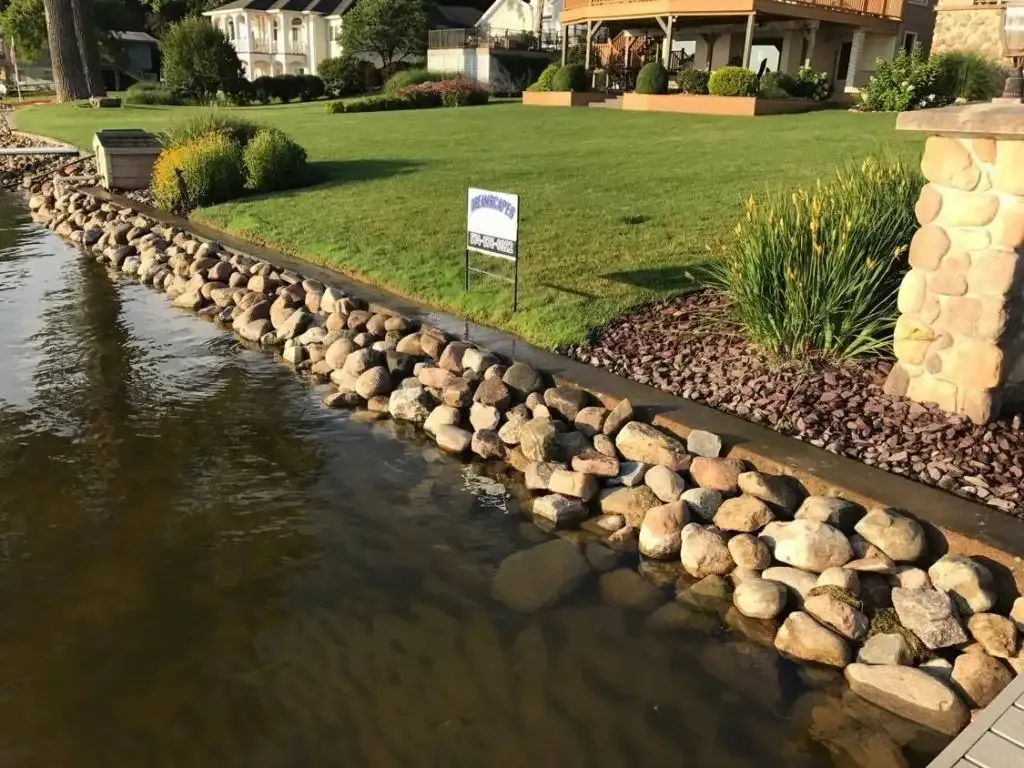
If your property already has a lawful seawall, the established upgrade is a glacial stone reface: rounded glacial stone placed against the lakeward face of the existing wall. TWF’s Healthy Shorelines program lists seawall refacing among the practices it funds. This is also the one shoreline construction project with its own general license under Indiana’s rules, meaning it can proceed without an individual permit if, and only if, it meets every condition in the rule. The conditions are specific, and the next section spells them out.
When Indiana law requires a permit first
What follows is a summary, not legal advice. The definitive answers come from the DNR Division of Water, which administers these rules and takes questions at 317-232-4160.
The baseline is Indiana’s Lake Preservation Act, IC 14-26-2. On a public freshwater lake, which Winona is, work at or lakeward of the shoreline requires written authorization from the DNR before it begins, unless a specific exemption or general license applies. The shoreline is the legal trigger: a planting entirely landward of it is ordinary gardening, while work at or beyond the water’s edge falls under the statute.
A general license is a set of conditions written into state rule; a project that meets every condition may proceed without an individual permit. The general license that covers seasonal piers and canvas boat lifts is covered separately in piers, lifts, and permits. DNR’s exemptions page describes them, and the one covering the glacial stone reface of an existing lawful seawall requires all of the following:
- Glacial stone only. No other facing material qualifies for the general license.
- No more than four feet lakeward. The stone may extend a maximum of four feet beyond the existing wall.
- Anchored filter cloth. The reface must include filter cloth anchored in place.
- No impermeable backing. The stone cannot be backed with impermeable material.
Temporary structures have general licenses too. A temporary pier qualifies when it is placed by the riparian owner, extends no more than 150 feet, and does not restrict navigation, so a seasonal pier does not normally require an individual permit.
The burden of proof falls on the property owner. Whoever claims that an exemption or general license applies must be able to prove it. If a contractor tells you no permit is needed, ask which general license the project falls under and how each condition is met.
Bioengineered projects are DNR’s preferred practice, but I could not verify a general license covering them, so do not assume the preference translates into a streamlined approval. Confirm the permitting path for a bioengineered design directly with the Division of Water.
State authorization is not the only layer, either. DNR’s exemptions page notes that federal permits from the U.S. Army Corps of Engineers and local floodplain requirements may still apply to the same project. The Division of Water can tell you which apply to yours.
Rules checked August 17, 2026. This summary reflects the DNR Division of Water’s exemptions page as of that date. Rules change; confirm current requirements with the Division of Water (317-232-4160) before starting any shoreline work.
Money and help
The Watershed Foundation’s Healthy Shorelines program is the local starting point for funding. It offers grant assistance and consultation to homeowners for shoreline projects that reduce erosion and runoff, and projects on any lake in the Tippecanoe River watershed are eligible, which includes Winona. Since 2011 the program has supported more than 150 projects and over 15,750 feet of shoreline on 18 lakes. Application cycles run annually.
The most recently posted Healthy Shorelines application deadline was August 1, 2026, which has passed. Check the program page for the next cycle and use its consultation request form in the meantime. Checked October 5, 2026.
Two other organizations can help. The Lilly Center for Lakes & Streams at Grace College publishes lake research and the native-plant guidance linked above. The Winona Lake Preservation Association, the lake’s own nonprofit since the 1970s, partners with TWF on shoreline and inlet work, including the Peterson Ditch project, and can be reached at winonalakepreservation@gmail.com. Our stewardship page collects all three, with ways to donate and get involved.
Habits that protect the shoreline you build
A planted buffer or a new stone face reduces what reaches the lake, but daily habits decide how much arrives at the buffer in the first place. Four apply whether or not you ever hire a contractor, all drawn from DNR and Lilly Center guidance:
- Use phosphorus-free fertilizer, if you fertilize at all. Established native plantings need none.
- Never fertilize before a heavy rain. Storm runoff carries fresh fertilizer to the lake before your lawn can use it.
- Pick up pet waste. The Lilly Center names animal waste as a leading source of E. coli in local water.
- Keep clippings and leaves out of the water. Yard debris carries nutrients with it; compost it or bag it well away from the bank.
Before you call a contractor
If you are planning shoreline work for next season, this sequence keeps the project inside the rules and connected to the help available:
- Walk your shoreline after a rain. Note where water enters the lake, where the bank is bare or slumping, and where turf runs to the edge.
- Sketch what you want. Decide which stretches get a buffer, which get plantings, and whether an existing seawall needs work.
- Contact The Watershed Foundation. Request a Healthy Shorelines consultation and ask about the next grant cycle before you price anything.
- Call the DNR Division of Water at 317-232-4160. Describe the project and ask which permitting path applies before any design is final.
- Then get bids. A contractor quoting shoreline work on Winona should be able to explain how the project satisfies the permit rules; the earlier calls let you check the answer.
For context on everything arriving upstream of your property, our watershed page maps the 18,730 acres that drain to the lake. The shoreline is the one part of that system a lakefront owner manages directly.
Support the organizations in this article
The Watershed Foundation funds and builds the upstream projects that protect the lake; it accepts a one-time donation or a monthly gift. The Winona Lake Preservation Association is the volunteer association on this lake, and it takes donations by Venmo and PayPal. The monitoring and research behind this article are the work of the Lilly Center for Lakes & Streams at Grace College, which accepts gifts toward its research and education.
More about the local organizations, and other ways to help, is on the stewardship page.
Sources
- Indiana DNR, Living With Lakes: native planting benefits, the Lakescaping addendum, the preference for bioengineered protection over concrete seawalls, and fertilizer guidance. Checked August 17, 2026.
- Indiana DNR Division of Water, permit exemptions and general licenses: the Lake Preservation Act baseline, glacial stone reface and temporary pier conditions, burden of proof, and other permits that may apply. Checked August 17, 2026.
- The Watershed Foundation, Healthy Shorelines: grant assistance, eligible practices, program totals since 2011, and the application cycle. Checked October 5, 2026.
- Lilly Center for Lakes & Streams, native plants: how native roots filter runoff and hold soil, and pointers to regional native-plant nurseries. Checked August 17, 2026.