Can you swim in Winona Lake?
Yes, in the ordinary week. No 2026 closure of the beach at Limitless Park has been reported, and the most recent beach sample, taken September 2, 2026, measured 64.4 CFU/100 mL of E. coli, well under the 235 CFU/100 mL the Lilly Center cites as the EPA's safety threshold. That answer changes with every weekly sample, so check the current numbers before you go; the rest of this article explains where they live and how to read them.
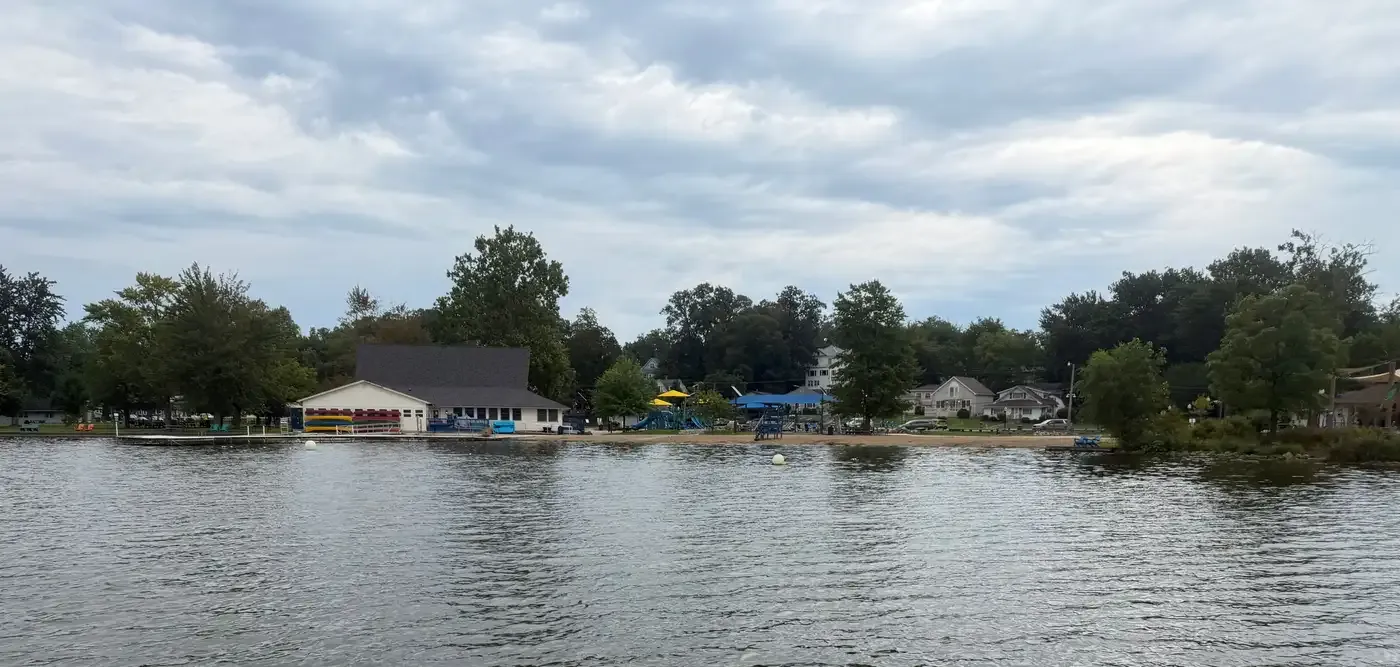
Whether Winona Lake is safe to swim in has a different answer in different weeks, so the useful skill is learning to look up the current one. For a lake of about 570 acres, Winona is unusually well monitored. The Lilly Center for Lakes & Streams at Grace College samples seven Kosciusko County beaches every week during the summer, Winona's public beach among them, and posts the results where anyone can read them.
The data pages leave one thing out: the Town of Winona Lake, which operates the beach at Limitless Park, makes the actual open-or-closed decision.
Check today's data first. Three links answer most of this question on any given day: the Lilly Center's E. coli results, updated weekly in summer; its microcystin (blue-green algae toxin) results, updated weekly from June through August; and the Town of Winona Lake parks page. Closures are announced through the town's channels, including its Facebook page, and do not appear on the Lilly data pages.
A worked example: the numbers on this article's check date
Snapshot, checked October 5, 2026. The Lilly Center's most recent beach result, sampled September 2, put Winona Lake Beach at 64.4 CFU/100 mL of E. coli, well below the 235 CFU/100 mL the page cites as the EPA's safety threshold. The two samples before it had read 161.6 on August 26 and 648.8 on August 12, nearly three times the line. The microcystin program's final round of the summer, sampled September 4, found none detected at both the open-water site and the beach, the second clean week in a row; on August 21 the open-water site had measured 1.074 ppb, above the 0.8 ppb pet threshold though well below the 8.0 ppb human one. Newer samples supersede these numbers as soon as they post; the current results live on the Lilly Center's E. coli and microcystin pages, not here. Treat this box as an example of how to read those pages, and use the live links before you swim.
Read together, those results say the beach had elevated bacteria in mid-August and had cleared by the end of the month, and that the open water briefly carried a toxin level that matters for dogs before testing clean a week later. What they do not say is whether the beach is open. A lab number by itself does not close the beach. Treat a high count as a reason to check the town's announcements before loading the car, and to wait for the next weekly sample. The sections below explain what each test measures, why the two are different, and why the numbers move around as much as they do.
What E. coli is and why the lake gets tested for it
E. coli is a bacterium that lives in the digestive tracts of warm-blooded animals, humans included. There are hundreds of varieties and only a few of them harm people, which is why its role in beach testing is mostly indirect: E. coli in lake water indicates that fecal contamination has reached the water, and fecal contamination travels with the pathogens that actually make swimmers sick. The Lilly Center's E. coli explainer covers the basics in more depth.
Around Winona Lake the plausible sources are the familiar ones: waterfowl such as gulls, ducks, and geese, livestock upstream in the watershed, human sources such as failing septic systems, and the storm drains that carry street runoff to the lake. As the Lilly Center's explainer puts it, "Rain collects E. coli from animal waste and disposes of it in the nearest body of water."
The health risks, per the CDC as summarized on that page, range from diarrhea and urinary tract infections to pneumonia and sepsis in serious cases. Children and adults over 65 are the most vulnerable groups, so a high count is a stronger reason to keep small kids out of the swimming area than to cancel an adult's paddleboard lap.
What CFU per 100 mL means
The unit on the E. coli page is CFU/100 mL: colony-forming units per 100 milliliters of water, a bit less than half a cup. The lab cultures each sample and counts the bacterial colonies that grow, and each colony traces back to viable bacteria in the original water. More colonies means more live E. coli in the sample. The page cites 235 CFU/100 mL as the EPA's safety threshold for recreational water, which put the August 12 beach reading of 648.8 at nearly three times that line and the August 26 reading of 161.6 comfortably under it. Beaches swing like that from week to week: in the August 26 round, Pike Lake Beach posted 613.1 while the other five monitored beaches ranged from 1.0 to 111.2.
Blue-green algae and microcystin: a separate test for a separate hazard

Blue-green algae, formally cyanobacteria, are organisms; microcystin is a toxin some of them can produce. The distinction matters because the Lilly Center's second weekly test measures the toxin itself, and because the two tests track different hazards that can move independently. A beach can post a high E. coli count with no detectable microcystin, which is exactly what Winona's mid-August snapshot showed, or the reverse.
For thresholds, the microcystin page cites IDEM, Indiana's environmental agency: 8.0 parts per billion for humans and 0.8 ppb for pets. The pet line sits at a tenth of the human one because dogs are at particular risk. They swallow lake water readily, and they lick algae off their fur after a swim. Winona's own open-water site measured 1.074 ppb on August 21, above the pet threshold, and tested at none detected a week later, which shows how quickly this moves.
For statewide context, IDEM's blue-green algae program runs its own sampling at selected state park swimming areas from Memorial Day to Labor Day, and its page notes the Lilly Center's county-level monitoring alongside it. The Lilly microcystin page updates weekly from June through August, with a fuller analysis published each October.
Why one number does not describe the whole lake
A beach sample describes the beach on the morning it was taken. The stream results posted alongside the beach data make the point: on August 20, Peterson Ditch, the inlet that drains farmland and neighborhoods south of the lake, measured 1,553.1 CFU/100 mL, while Eagle Creek, the lake's outflow, sat at 44.3. Water entering Winona Lake can carry many times the bacteria of water leaving it, with the lake diluting and settling what the streams deliver in between. Where you swim relative to an inlet matters, and the open water in the middle of the lake is a different environment from the beach shallows where samples are drawn.
Sampling frequency is the other limit. In the Lilly Center's words, "We sample 14 streams every other week, all year round, and 7 beaches during the summer," and the E. coli page is updated weekly by its research team. Every posted number is a snapshot from a sampling day, and conditions can change between visits in either direction. The watershed page on this site maps the ditch systems behind those stream numbers.
Rain changes the numbers
The most predictable driver of a bad E. coli week is a storm. Winona Lake's watershed covers 18,730 acres by the Lilly Center's measure, and rain falling anywhere on it washes toward the lake through a handful of ditches, collecting animal waste along the way. That is the mechanism behind the Lilly quote above, and it is why a beach that tested fine on Tuesday can be a poor choice on Saturday if heavy rain fell on Friday. The next sample may not be taken for days, so after a big storm the freshest posted number can already be stale.
This site covers the runoff sequence in detail in what happens to Winona Lake after heavy rain. For current conditions and the five-day forecast, see Lake Today, and the timelapse page shows how quickly weather moves across the lake.
Who actually closes the beach
The Lilly Center publishes measurements. Closure authority sits with the Town of Winona Lake, which runs Limitless Park. The distinction played out in July 2025: on Tuesday, July 1, the town announced on its Facebook page that the Limitless Park beach was temporarily closed over high E. coli counts, as WSBT reported, and by Wednesday, July 2 it had reopened after health-department test results came back at safe levels. The whole closure lasted about a day.
As of this article's check date, October 5, 2026, I found no news reports of a 2026 closure at Winona Lake. Absence of coverage is weaker evidence than an official all-clear, so treat the town's parks page and its Facebook announcements as the deciding source, whatever the latest lab numbers show.
Before you swim: the short checklist
The routine for a swim day comes down to five habits:
- Check the two data pages. The E. coli results and the microcystin results, with 235 CFU/100 mL and 8.0 ppb as the reference lines.
- Get the park details separately. Hours, parking, rentals, and the splash pad are on the beach and splash pad page.
- Check the town's announcements. The parks page and the town's Facebook channels carry any closure notice; the data pages do not.
- Skip swimming right after heavy rain. Runoff raises bacteria counts before the next sample can catch it, so give the lake a day or two after a big storm.
- Keep dogs away from visible scums. The pet threshold for microcystin is a tenth of the human one, and dogs both drink lake water and lick their fur clean afterward.
- Rinse off after swimming. Microcystin can cause harm when it is left on skin, and a freshwater rinse is a good habit after any lake swim.
Most weeks the routine ends in a swim. Two weeks after the mid-August sample flagged Winona Lake Beach, the August 26 round had it back under the 235 line, and the August 28 microcystin test found nothing at either Winona site. A two-minute check before you drive over tells you which situation you have.
Support the organizations in this article
The monitoring and research behind this article are the work of the Lilly Center for Lakes & Streams at Grace College, which accepts gifts toward its research and education.
More about the local organizations, and other ways to help, is on the stewardship page.
Sources
- Lilly Center for Lakes & Streams, E. coli data: weekly beach and stream E. coli results, including the August 12 and August 26, 2026 Winona Lake Beach samples and the EPA threshold citation. Checked October 5, 2026.
- Lilly Center for Lakes & Streams, "What is E. coli and how to prevent it": what E. coli is, where it comes from, and CDC-cited health risks. Checked August 17, 2026.
- Lilly Center for Lakes & Streams, microcystin data: weekly blue-green algae toxin results and the IDEM thresholds for humans and pets. Checked October 5, 2026.
- IDEM blue-green algae program: statewide sampling and advisory program for cyanobacteria at public swimming areas. Checked August 17, 2026.
- WSBT, Limitless Park beach closure (July 1, 2025): the town's temporary closure over high E. coli counts. Checked August 17, 2026.
- WSBT, Limitless Park beach reopening (July 2, 2025): reopening after health-department test results. Checked August 17, 2026.
- Town of Winona Lake, Parks & Recreation: the town department that operates Limitless Park and its beach. Checked August 17, 2026.