In August, the surface of Winona Lake and the water 70 feet below it are in different seasons. The top few feet are warm enough for a comfortable swim. Down in the 79-foot hole that the Indiana DNR mapped in its 2017 depth survey, the water is cold, dark, and by late summer often short on oxygen. The two sit in the same basin for months without ever trading places, which is why the Winona Lake water temperature you feel at the beach tells you almost nothing about conditions 40 feet down.
That separation is called stratification, and it is ordinary physics for a deep lake in a temperate climate. Warm water is less dense than cold water, so once late-spring sun heats the surface, the warm water floats on the cold water below and wind can no longer stir the full depth of the lake. Twice a year, when surface and bottom temperatures converge, the layers collapse and the whole lake mixes from top to bottom. That mixing is called turnover, and the yearly rhythm of layering and turnover sets the schedule for much of what happens in the lake, from where fish can live to when algae grows.
About the numbers below: the Lilly Center for Lakes & Streams at Grace College monitors Winona Lake, but its most detailed public stratification figures come from a case study of nearby Lake Wawasee using 2020 data. I cite those figures as a local example of the pattern, not as Winona measurements. No Winona-specific turnover dates, layer depths, or oxygen profiles appear here because none are published. Checked August 17, 2026.
Summer: a lake in three layers
Through the warm months, a stratified lake divides into three layers that do not mix. The top layer is warm, sunlit, and stirred daily by wind; it holds the swimmers, the boats, and most of the active food web. The bottom layer is cold and dark, insulated from the summer above it. Between them lies a transition zone where the temperature drops sharply with depth. Anglers know the top of that zone as the thermocline. If you have ever dived down from a boat or a pier and hit a band of markedly colder water a body length or two beneath the warm surface, you have felt that boundary yourself.
The layering matters because dissolved oxygen cannot flow between the layers while the lake is stratified, as the Lilly Center explains in its lake temperature explainer. The surface keeps collecting oxygen from the air and from photosynthesis all summer. The deep layer is sealed off from both sources, so it lives on the oxygen it carried down during spring mixing while decomposition on the lake bottom steadily draws that supply down.
The Wawasee case study puts numbers to the imbalance. Across 2020, dissolved oxygen at the surface of Lake Wawasee stayed between 8.1 and 14.8 mg/L. At the bottom it ranged from 13.8 mg/L all the way down to 0.1 mg/L, with the low readings arriving while the lake was stratified. The Lilly Center notes that most fish need more than 2.0 mg/L of dissolved oxygen to survive, so by late summer the deepest water in a stratified lake is closed to them until turnover reopens it.
Winona has the kind of basin where this pattern develops. The main basin reaches 79 feet at its deepest point in the Indiana DNR's August 2017 bathymetric survey, and the lake as a whole averages about 30 feet deep. Not every corner behaves the same way, though. The northwest arm, where Eagle Creek leaves the lake, runs mostly under 10 feet, and water that shallow tracks the air temperature and mixes readily in wind. Deep summer layering belongs to the main basin.
Fall turnover: the lake mixes itself
As autumn air cools the surface, the density difference holding the layers apart fades. Cooled surface water sinks and mixes a little deeper each week, and once the whole water column sits near one temperature, an ordinary windy day can stir the lake from top to bottom. This is fall turnover, and it happens on deep Indiana lakes every year. In the Lilly Center's 2020 Wawasee data the fall mixing came in November, though the timing shifts with the weather from year to year and lake to lake.
Turnover redistributes what summer had separated. Oxygen-rich surface water reaches the bottom for the first time in months, and nutrients that accumulated in the deep water rise back toward the light. The Lilly Center calls turnover "an ecological reset button," which is a fair description of what it does for fish: with oxygen restored at every depth, the full lake is open to them again instead of just the band above the thermocline.
Winter: slow life under the ice
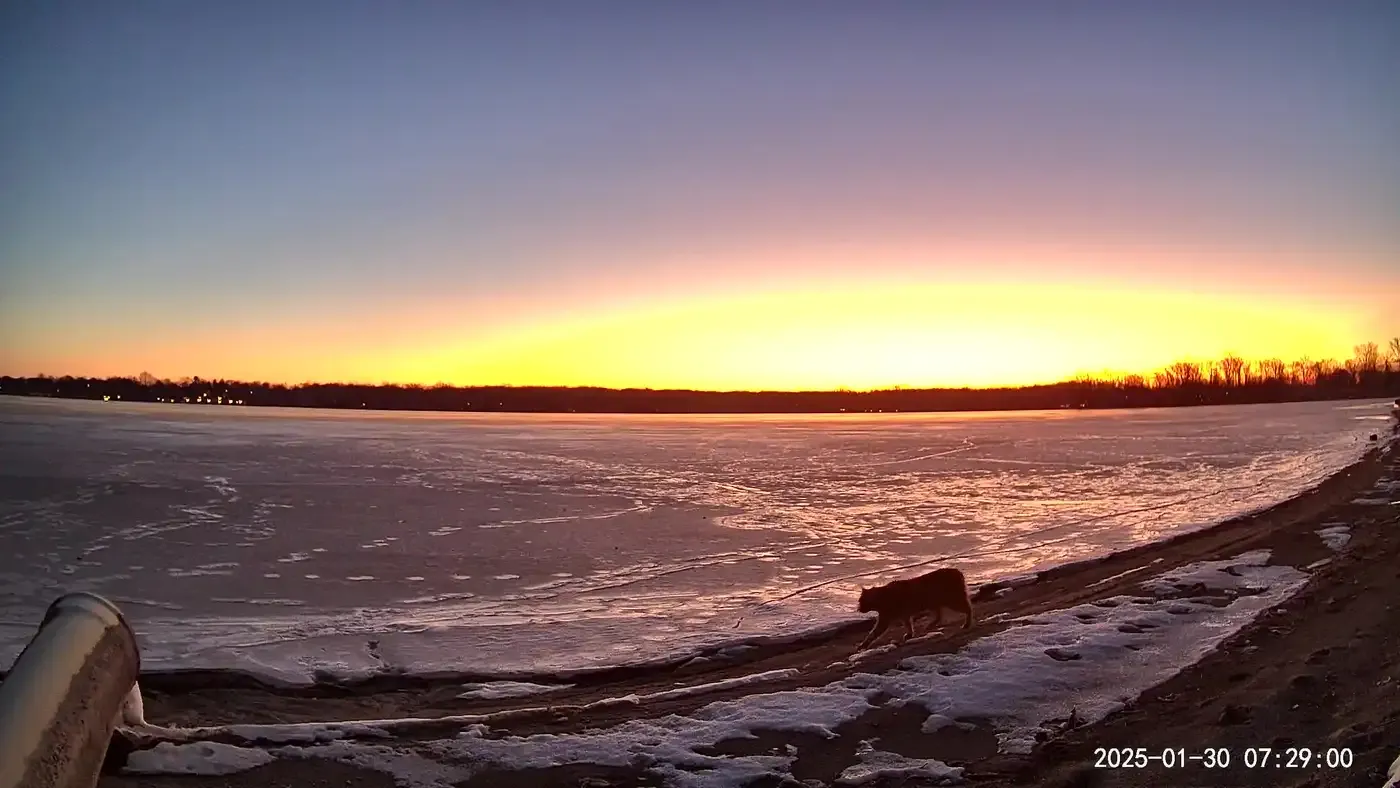
Water behaves oddly near its freezing point. It is densest a few degrees above 32°F, so the coldest water floats instead of sinking, and a lake freezes from the top down. Beneath the ice, the water near the bottom holds around 35°F all winter, according to the Lilly Center's explainer on fish in winter. The ice cap also seals the lake off from wind and air, so the water column below it sits still for the season.
Fish respond by entering torpor, a dormancy in which heartbeat, breathing, and muscle activity all slow. They hold in that stable 35-degree water near the bottom and burn very little energy until spring.
Oxygen is the constraint under the ice. No new oxygen enters from the atmosphere while ice covers the lake, and decomposing plants on the bottom consume oxygen all winter long. The balance hinges on light. Clear ice passes enough sunlight for plants and algae to keep photosynthesizing underneath it, adding oxygen back to the water. Heavy snow sitting on the ice blocks that light, photosynthesis stops, and the oxygen supply can only fall from there. If it drops below what fish need before the ice goes out, the result is winterkill: fish suffocating under a lid they cannot escape. Long stretches of deep snow cover on the ice carry the most risk.
Ice safety: the Lilly Center's baseline guidance for anyone walking on lake ice is a minimum of four inches of ice, a life jacket, and a companion. Treat four inches as a minimum, not a guarantee. Thickness varies across a single lake, and no ice is ever guaranteed safe. Checked August 17, 2026. Indiana's full thickness guidance, the hazard shoreline aerators create, and the ice fishing rules are covered in the ice safety article.
Spring: the second turnover
When the ice goes out, the surface warms from the mid-30s toward the temperature of the deep water, and for a short window the water column is nearly uniform again. Wind finishes the job, giving the lake its second full mixing of the year. In the 2020 Wawasee data this spring turnover came in April. The mixing matters well beyond the moment it happens, because it refills the deep basin with the oxygen that has to last through the coming summer's stratification. From there the strengthening sun warms the surface faster than wind can carry the heat downward, the layers rebuild, and the cycle begins again.
What the cycle means above the surface
Algae season and stratification arrive together, and for the same reason. Blue-green algae favors warm, sunlit, stable water, and the summer surface layer supplies exactly that, which is why the Lilly Center runs its weekly algae-toxin monitoring from June through August. Once fall turnover cools and stirs the surface, those growing conditions fall apart until the next stratified season. The nutrient side of that story is covered in our water quality article.
Anglers track the cycle because it moves the fish. In summer the usable water is squeezed between a warm surface and an oxygen-poor bottom, which concentrates fish along the thermocline and the structure that intersects it. On Winona that structure means drop-offs: the west side falls away quickly, and the contour steps between 10 and 30 feet on the west and east sides and around the mid-lake shoals give bass, walleye, and perch edges to hold on. The fishing guide covers that structure in detail. After turnover the pattern loosens, because oxygen no longer fences fish out of the depths.
Clarity shifts with the calendar too. Turnover stirs the whole lake and moves nutrients and settled material through the water column, while summer clarity rises and falls with how much algae is growing in the sunlit layer. If the water looks different in October than it did in July, the mixing cycle is often part of the reason.
Watching it happen
Most of this cycle runs out of sight, but the visible parts are easy to follow. The timelapse page compresses the surface seasons, from open water to ice and back. The Lake Today page carries current conditions and a five-day forecast, useful for spotting the cool, windy autumn stretches when turnover weather arrives. And the depth map shows the 79-foot main basin that makes summer stratification possible in the first place.
Support the organizations in this article
The monitoring and research behind this article are the work of the Lilly Center for Lakes & Streams at Grace College, which accepts gifts toward its research and education.
More about the local organizations, and other ways to help, is on the stewardship page.
Sources
- Lilly Center: How does temperature affect lakes?: the Lake Wawasee 2020 stratification and turnover case study cited throughout. Checked August 17, 2026.
- Lilly Center: Fish and their habitat during winter: under-ice temperature, torpor, winter oxygen dynamics, and ice safety minimums. Checked August 17, 2026.
- Lilly Center: Winona Lake profile: depth, area, and watershed figures for Winona Lake. Checked August 17, 2026.